Ecological tristability driven by total carbon availability over resource complexity in a synthetic microbial community

Ecological tristability driven by total carbon availability over resource complexity in a synthetic microbial community
Bischofberger, A. M.; Cairns, J.; Aapalampi, I.-K.; Pausio, S.; Lindqvist, M.; Mustonen, V.; Hiltunen, T.
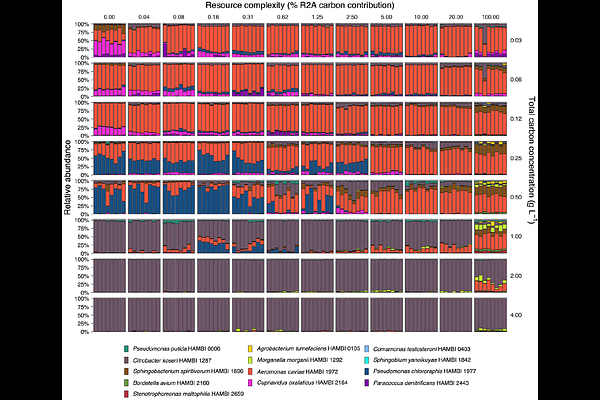
AbstractEven though complex microbial communities are ubiquitous and provide essential services for natural and human-associated ecosystems, our knowledge about their assembly and dynamics is incomplete. There is an ongoing debate whether the behavior of complex communities can be predicted from the outcome of pairwise competition of species, and whether communities reach alternative stable states depending on the level and complexity of resource provided for growth. To estimate the effect of two resource gradients, total carbon availability and resource complexity, on the compositional dynamics of a complex microbial community, we conducted a 16-day serial passage experiment, transferring a 16-species synthetic community in 96 different resource environments. We observed that although both resource dimensions influenced community composition, total carbon exerted a considerably larger effect. Additionally, we saw the emergence of a tristable pattern along the total carbon gradient, a feature not observed for the resource complexity gradient. Using monoculture assays, we identified lag phase duration as the dominant predictor of competitive success at carbon extremes, with maximum growth rate increasing in importance as lag times converged. Total carbon availability thus structured community state transitions and regulated which growth trait governed competitive sorting. These results suggest the importance of total carbon level over resource complexity and identifying dominant species for the quest to successfully manage, maintain and manipulate complex microbial communities.