A Rapid Reversed-Phase LC-MS Method for Polar Metabolite Profiling

A Rapid Reversed-Phase LC-MS Method for Polar Metabolite Profiling
De Neys, M.; Geuer, J. K.; Pontrelli, S.
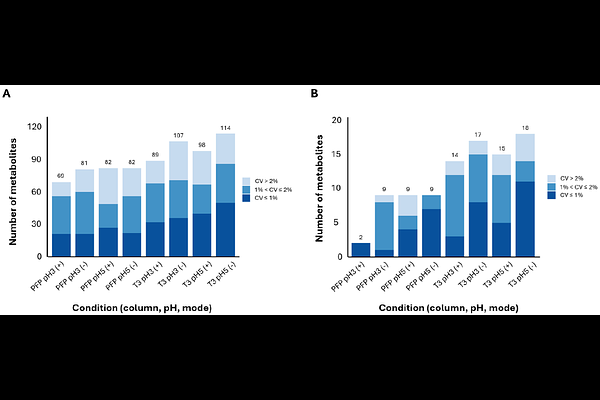
AbstractPolar metabolites, including amino acids, nucleotides, phosphorylated metabolites, and central carbon intermediates, drive essential physiological processes but remain difficult to measure by high-throughput, reversed-phase liquid chromatography-mass spectrometry (LC-MS) due to poor retention on conventional stationary phases. Here, we establish a 3-minute injection-to-injection LC-MS method and systematically evaluate two best-in-class solid-core reversed-phase chemistries for profiling 123 biologically relevant polar metabolites, directly comparing T3-type C18 and pentafluorophenyl (PFP) stationary phases. We benchmark retention time (RT), peak shape, reproducibility, coverage, and analytical sensitivity under acidic and mildly acidic conditions. Across eight conditions, median RT coefficients of variation (CV) ranged from 1.05 - 1.48%, with narrow chromatographic peaks (median full width at half maximum {approx} 1.0 s), demonstrating stable performance under rapid gradients. The T3 column operated at pH 5 provided the highest coverage (114 of 123 metabolites) and detected 18 of 20 phosphorylated compounds, compared to 82 metabolites and 9 phosphorylated compounds under the best-performing PFP condition. Median limits of detection reached 0.02 mol/L. Because most metabolites eluted within the first column volumes, we implemented iterative data-dependent MS/MS acquisition to improve compound annotation under short-gradient conditions, acquiring fragmentation spectra for 86 compounds in the 123 metabolite mixture without extending runtime. Performance in Escherichia coli intracellular extracts was robust over 480 consecutive injections, with median RT CVs of 1.7% and consistent peak shapes. Across all evaluated metrics, the T3 stationary phase consistently outperformed PFP. Together, these results define a rapid and robust reversed-phase LC-MS workflow optimized for scalable profiling of polar and phosphorylated metabolites in high-throughput biological studies.