MAIT cells exacerbate liver fibrosis by downsizing the intrahepatic regulatory T cell compartment

MAIT cells exacerbate liver fibrosis by downsizing the intrahepatic regulatory T cell compartment
Wang, N. I.; Shydlouskaya, V.; Reid, K. R.; Mahendran, A.; Schincaglia, A.; Keller, B. A.; Zia, S. Q.; Movasseghi, A. R.; Haruna, J.; Godfrey, D. I.; Haeryfar, S. M. M.
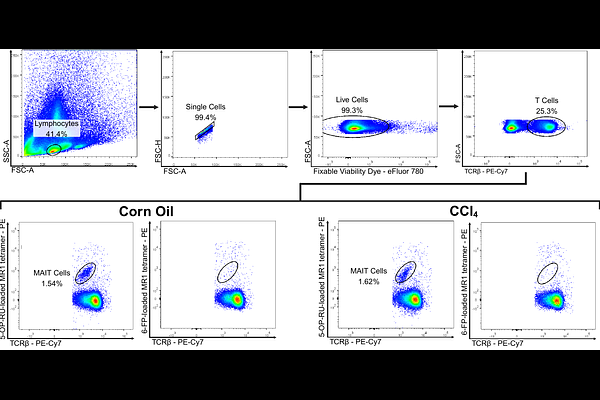
AbstractMucosa-associated invariant T (MAIT) cells have been paradoxically implicated in both tissue repair and fibrosis. However, when and how they modulate fibrogenesis in the injured liver remain unclear. Here, using the carbon tetrachloride-induced model of liver injury in MR1- and MAIT cell-sufficient and -deficient mice, we identify MAIT cells as an early driver of fibrogenesis. The presence of MAIT cells exacerbated hepatocellular injury, myofibroblast activation, and matrix deposition early in the course of fibrosis development, but not at later stages. This was accompanied by rapid polarization of hepatic MAIT cells toward a MAIT17 phenotype and enrichment of pro-fibrotic transcriptional programs. Concurrently, MAIT cells acquired an exhaustion-associated phenotype while still retaining their effector functions. Mechanistically, we demonstrate that MAIT cells limit hepatic regulatory T (Treg) cell accumulation, accompanied by reduced Ki-67 and CXCR3 levels in the latter population, suggesting their impaired proliferation and tissue recruitment. Furthermore, Treg cell inactivation reversed MAIT cell-dependent differences in the severity of fibrosis, establishing Treg cells as a key downstream mediator. Together, these findings identify MAIT cells as early orchestrators of fibrogenesis and reveal a novel MAIT-Treg axis that can be considered a potential therapeutic target in the early stages of fibrotic diseases.