Posterior simulation-based calibration tests of phylogenetic dating methods

Posterior simulation-based calibration tests of phylogenetic dating methods
King, B.
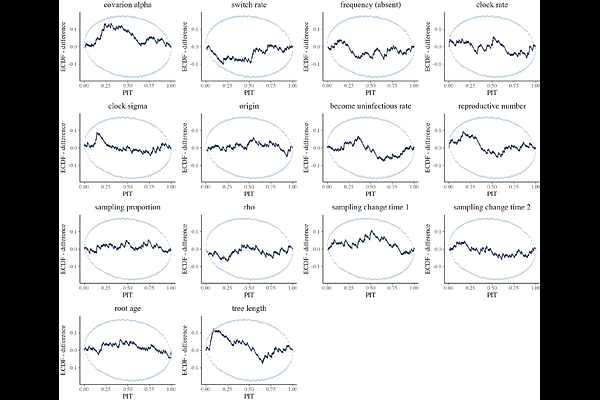
AbstractSimulation-based calibration (SBC) checking is a method to ensure that the inference machinery for a Bayesian statistical analysis is functioning in a correct and unbiased manner. Typically, SBC begins with sampling parameter values from the model priors (prior SBC). However, it has been shown that prior SBC can miss problems when these manifest only in certain regions of parameter space. In phylogenetics, this is relevant not only because of the vastness of tree and parameter space, but also because many phylogenetic analyses involve some degree of model misspecification. Posterior SBC is a recently developed method for checking that the inference algorithms function correctly for a given empirical dataset. Here I use posterior SBC to test the implementation of phylogenetic dating methods in the inference software BEAST 2. I test both the tip-dated approach, employing an Indo-European vocabulary dataset, and the node-dated approach, employing a molecular rRNA dataset of Tabanidae (horseflies). In both cases, posterior SBC tests indicate good calibration. Despite this, posterior predictive datasets simulated from the posterior distribution provided no further increase in the precision of node age estimates compared to the original posterior, a result consistent with previous literature showing fundamental theoretical limits to the identifiability of node ages. Nevertheless, these results suggest that phylogenetic dating methods in BEAST 2 are not biased by problems with the inference machinery, thereby increasing confidence in results obtained using these methods.