Semen collection, short term storage, and cryopreservation in the Texas horned lizard (Phrynosoma cornutum)

Semen collection, short term storage, and cryopreservation in the Texas horned lizard (Phrynosoma cornutum)
Julien, A. R.; Griffioen, J. A.; Perry, S. M.; Doege, R.; Burger, I. J.; Barber, D. R.
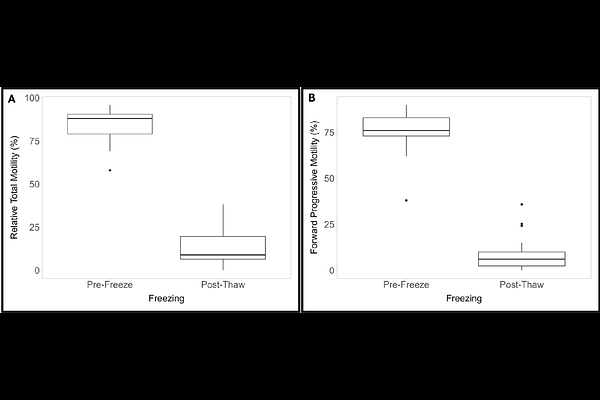
AbstractAs global reptile populations continue to decline, improving reproductive success in managed populations of listed species, such as Phrynosoma cornutum (the Texas horned lizard) has become increasingly critical for species survival. One understudied area of reproductive research in reptile species is gamete collection and storage, a crucial component for maintaining genetic diversity. In Texas, semen was collected from wild P. cornutum (n = 20) in June 2025. Semen collection was performed via electroejaculation (EEJ) under alfaxalone anesthesia. Prior to semen collection, snout-vent-lengths (SVL) and weights were recorded and testes measurements were taken using a portable ultrasound. Average sperm motility and concentration across all lizards was 83.7% and 85.7 x 10⁶ sperm/mL, respectively. While lizards with longer SVLs had higher sperm motility, weight and testis size did not affect sperm parameters. Samples were extended in INRA96 and divided for use in cold-storage longevity or cryopreservation trials. Samples under cold-storage conditions were assessed for motility daily for 10 days. Motility was not significantly reduced until 48 hours post-collection and maintained 19% motility at day 10. For cryopreservation, samples were diluted 1:1 in INRAFreeze cryopreservation media and frozen in liquid nitrogen, then immediately thawed. Average post-thaw sperm motility was 13.9%, with the highest post-thaw motility recorded at 38.2%. This is the first report of semen storage and cryopreservation in Phrynosoma and provides valuable insight into semen storage potential in reptile species.