Volumetric Scattering Microscopy

Volumetric Scattering Microscopy
Gao, Z.; Han, K.; Ling, Z.; Zhang, H.; Botchwey, E.; Liu, W.; Hua, X.; Nie, S.; Jia, S.
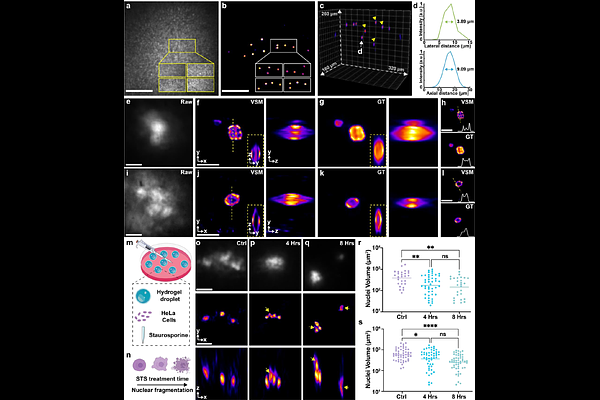
AbstractOptical scattering in biological tissues fundamentally limits fluorescence imaging by disrupting spatial and angular information, thereby restricting volumetric visualization. Although hardware-intensive and computational approaches have advanced scattering microscopy, practical three-dimensional imaging through tissue remains constrained by instrumental complexity and axial ambiguity. Here, we present volumetric scattering microscopy (VSM), a scan-free, optical-computational framework for three-dimensional fluorescence imaging in scattering biological media. VSM captures angularly resolved speckle-encoded fluorescence using an aperture-segmented Fourier light-field configuration and reconstructs volumetric structure through adaptive feature-based descattering and joint sub-pupil alignment. This hybrid strategy preserves angular information embedded in scattered light without wavefront measurement or mechanical scanning, while maintaining the simplicity of a standard epi-fluorescence architecture. We demonstrate high-fidelity volumetric reconstruction across phantoms, engineered cellular systems, ex vivo tissues with volumetric muscle loss, and intact Xenopus embryos, achieving preserved spatial resolution, enhanced optical sectioning, and quantitative accuracy under strong scattering conditions. VSM supports large-field, robust volumetric imaging in both layered and fully embedded scattering environments. By transforming scattered light into a structured encoding resource, VSM establishes a scalable pathway toward routine three-dimensional fluorescence imaging in complex biological systems.