A New Method for Constraining 3D Exoplanet Atmospheres: Application to WASP-94A b's Panchromatic Spectrum

A New Method for Constraining 3D Exoplanet Atmospheres: Application to WASP-94A b's Panchromatic Spectrum
Sagnick Mukherjee, Luis Welbanks, Guangwei Fu, David K. Sing, Michael R. Line
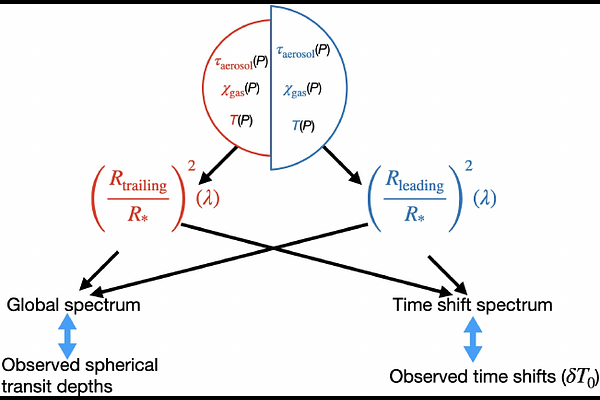
AbstractA growing number of transiting exoplanets exhibit spectroscopic evidence that their leading and trailing limbs differ. Interpreting these observations is now the limiting step. The standard approach of fitting limb-resolved transit depths results in highly anti-correlated transit depths, and treating them as independent measurements can result in strongly biased ($3σ$) retrieved molecular abundances. We present an inference framework that avoids these correlations by using the temporal signature of limb asymmetry instead. This wavelength-dependent shift in mid-transit time, or `time-shift spectrum', carries the limb-asymmetry information, is measurable from existing light curves with a spherically symmetric transit model, and is uncorrelated with the spherically-averaged transit depth. Simultaneously fitting the resulting transmission and time-shift spectrum with an independent atmospheric column for each limb enables the retrieval of limb-resolved properties from two independent measurements. We demonstrate that this approach reduces the mean squared error on the retrieved molecular abundances by factors of $\sim30-50$ relative to next best of the alternative approaches currently adopted in the field, and improves retrieved abundance precision by $\sim3-6\times$. We apply the framework to WASP-94A b and present its panchromatic limb-resolved spectrum, spanning 0.8-5~$μ$m and combining NIRISS/SOSS and NIRSpec/G395H observations. The planet's morning limb remains aerosol-obscured across this entire range, while its evening limb constrains the abundances of H$_2$O, CO$_2$, CO, and H$_2$S. We measure a limb-to-limb temperature difference of $415\pm58$~K at 1~mbar. This limb-resolved analysis finds [M/H]=+0.32$^{+0.11}_{-0.11}$ and C/O=0.724$^{+0.013}_{-0.013}$, consistent with the host star.