Chemical Taxonomy of $ω$~Centauri: Ten Populations Reveal a Multi-Phase Enrichment History

Chemical Taxonomy of $ω$~Centauri: Ten Populations Reveal a Multi-Phase Enrichment History
Furkan Akbaba, Olcay Plevne, Timur Şahin, Sena Aleyna Şentürk
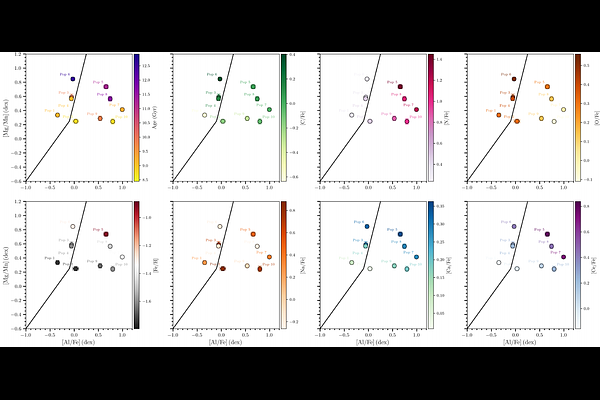
Abstract$ω$~Centauri, the most massive globular cluster in the Milky Way, exhibits a level of stellar population complexity that has long resisted a unified chemical characterisation. We exploit high-resolution near-infrared spectroscopy from the Milky Way Mapper survey (MWM DR19) to construct one of the largest homogeneously analysed samples of $ω$~Cen members to date. Applying Ward-linkage hierarchical clustering in a seven-dimensional chemical abundance space, without prior assumptions on population number or boundaries, we identify ten chemically distinct stellar populations. Their nucleosynthetic signatures trace four enrichment channels: iron-peak, $α$-element, CNO-cycle, and high-temperature proton-capture processes. The populations organise into two dominant groups separated by a large light-element spread at a modest iron baseline, consistent with AGB-driven self-enrichment. This dichotomy reflects distinct enrichment pathways: core-collapse supernovae establish the iron baseline, while AGB stars dominate light-element and $s$-process enrichment. A decoupled rise in $s$-process abundances relative to iron-peak elements, together with sub-dominant Type~Ia contributions across all metallicities, indicates evolution on timescales shorter than the characteristic Type~Ia delay time. One intermediate-metallicity population retains a primordial composition, providing evidence for spatially segregated enrichment within the progenitor. The most metal-rich component may trace star formation continuing after accretion into the Milky Way halo. All populations lie in the accreted regime of the $[\mathrm{Al/Fe}]$--$[\mathrm{Mg/Mn}]$ plane, supporting an ex-situ origin. These results reinforce the interpretation of $ω$~Cen as the remnant nucleus of an accreted dwarf galaxy and provide a framework for future chemo-dynamical studies.