Modeling supernova feedback in galaxy formation simulations with energy-conserving momentum injection

Modeling supernova feedback in galaxy formation simulations with energy-conserving momentum injection
Takashi Okamoto
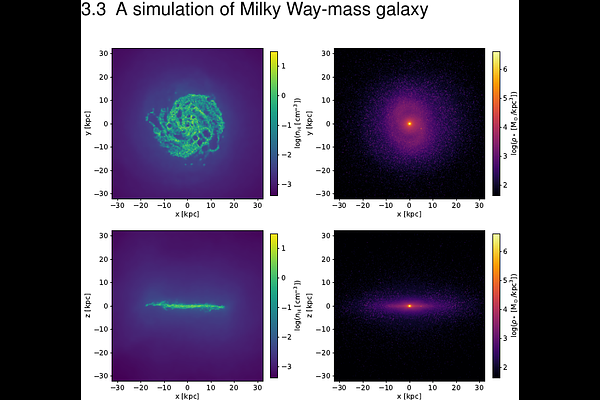
AbstractAccurate modeling of supernova (SN) feedback in galaxy formation simulations is complicated by violations of energy conservation arising from the vector nature of momentum injection. We present a new mechanical feedback scheme that addresses two sources of such violations: the relative motion between gas elements and the SN-hosting star particle, and multiple momentum injections into a single gas element within one timestep. By computing the kinetic energy increment in the rest frame of the gas element, our method ensures energy conservation while avoiding inversion of the momentum increment that can occur in the lab frame. This correction, however, inherently violates momentum conservation, which can disturb angular momentum distribution and hinder disk formation when momentum is coupled on galactic scales. To prevent unphysical large-scale coupling for SNe in low-density environments without introducing an ad hoc maximum radius, we switch to purely thermal feedback when the cooling radius is resolved by the local inter-element separation. Using cosmological zoom-in simulations of dwarf galaxies with halo masses $M_\mathrm{vir} \sim 10^{11},\mathrm{M}_\odot$ at two resolutions differing by a factor of eight, we show that our scheme achieves good convergence in star formation histories. Without the correction for multiple injections, stellar mass in low-resolution runs can drop to 59% of that in high-resolution counterparts, worse than in our fiducial scheme. At feedback strengths reproducing dwarf galaxy stellar masses, a Milky Way-mass galaxy simulation ($M_\mathrm{vir} \sim 1.8\times10^{12},\mathrm{M}_\odot$) overproduces stellar mass, suggesting additional feedback such as AGN feedback is required.