Tricuspid valve regurgitation accelerates heart failure via a cardio-intestinal innate immune circuit

Tricuspid valve regurgitation accelerates heart failure via a cardio-intestinal innate immune circuit
Sicklinger, F.; Thiemann, T.; Rupprecht, S.; Quadt, L.; Amrute, J. M.; Zuchgan, J.; Voran, J. C.; Markousis-Mavrogenis, G.; Isasi Nalvarte, A.; Wienecke, L. M.; Hartmann, N.; Erbe, S.; Hoerbrand, I. A.; Kraus, M. J.; Gruber, M.; Bibernell, R.; Martini, S.; Kilian, L. S.; Hund, H.; Boeckel, J.-N.; Mack, M.; Voors, A. A.; van der Meer, P.; Frank, D.; Frey, N.; Lavine, K.; Konstandin, M.; Leuschner, F.
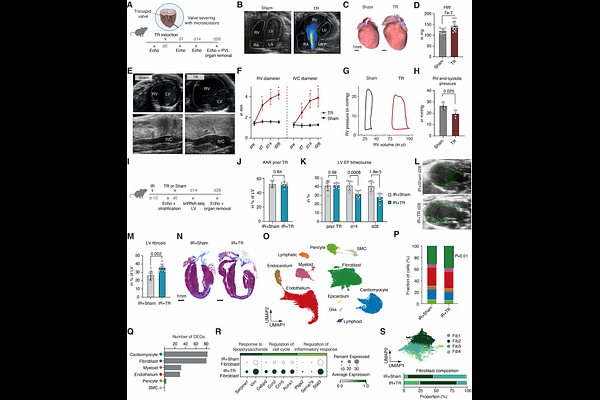
AbstractActivation of the immune system impacts the progression of heart failure (HF), but the underlying mechanisms remain incompletely understood. Here, we identify a cardio-intestinal innate immune axis that links systemic venous congestion to myocardial inflammation, fibrosis, and functional decline. Using single-cell and single-nucleus transcriptomic profiling in patients and mice with tricuspid regurgitation (TR), we demonstrate that TR disrupts intestinal barrier integrity and elicits expansion of circulating monocytes which in turn orchestrate pathological crosstalk between the right and left heart. Monocyte-derived Interleukin-6 (IL-6) emerged as a key mediator of TR-driven myocardial fibrosis and dysfunction. Blockade of IL-6 attenuated cardiac fibrosis and improved cardiac function. In patients, catheter-based repair of TR resulted in reduced IL-6 levels. Together, these findings establish cardio-intestinal innate immunity as a mechanism linking altered hemodynamics to left ventricular remodeling and nominate TR patients as a selective target population for IL-6-directed therapy in HF.