Overgrazing drives ant diversity loss and community homogenization in the Tumbesian dry forest in Ecuador

Overgrazing drives ant diversity loss and community homogenization in the Tumbesian dry forest in Ecuador
Gusman Montalvan, P.; Velez-Mora, D. P.; Ramon, P.; Gusman Montalvan, E.; Dominguez, D.; Donoso, D. A.
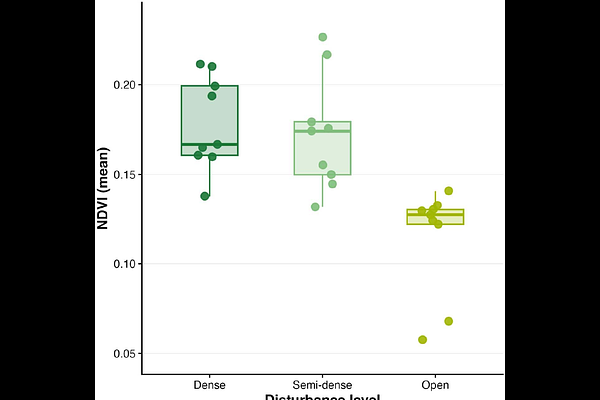
Abstract1. Tropical dry forests are among the most threatened ecosystems globally, yet the consequences of livestock overgrazing for ant communities remain poorly documented, particularly in the Tumbesian biodiversity hotspot of southwestern Ecuador, where uncontrolled goat grazing constitutes the dominant disturbance agent. 2. We sampled ant communities (Formicidae) across a goat-grazing disturbance gradient in Zapotillo (Loja Province, Ecuador), establishing three disturbance levels (Dense, Semi-dense, and Open Forest) with nine 60 x 60 m plots per level (n = 27) and 486 pitfall traps. Community responses were assessed using abundance-based and presence/absence analyses of morphospecies richness, Hill-number diversity, community composition, beta diversity decomposition, and functional guild structure; vegetation structure was characterized using satellite-derived NDVI. 3. We recorded 47,459 individuals belonging to 22 morphospecies in six subfamilies. Morphospecies richness declined with disturbance (Dense: 19, Semi-dense: 15, Open: 12), with four specialist genera exclusive to Dense Forest. Beta diversity decomposition revealed a shift from turnover-dominated dissimilarity at moderate disturbance to nestedness-dominated dissimilarity at high disturbance, indicating progressive habitat filtering as the dominant community-restructuring process. 4. Community composition differed among disturbance levels (PERMANOVA: F = 4.49, R2 = 0.272, p = 0.001) and was correlated with NDVI (r2 = 0.341, p = 0.013). Cryptic/soil and Leaf-cutter guilds were nearly eliminated from Open forest while the Opportunist guild expanded markedly, indicating that functional homogenization precedes detectable taxonomic impoverishment. 5. Overgrazing drives directional ant diversity loss and biotic homogenization at both taxonomic and functional levels in the Tumbesian dry forest, underscoring the conservation value of intact Dense forest.