Impact of Satellite Constellations on Observations with the 80-cm Telescope and the Mini-SiTian at the Xinglong Observatory, NAOC

Impact of Satellite Constellations on Observations with the 80-cm Telescope and the Mini-SiTian at the Xinglong Observatory, NAOC
Jing Ren, Zhou Fan, Hong-rui Gu, Qi-qian Zhang, Yun-fei Xu, Jun-ju Du, Xiao-han Chen, Lin-ying Mi, Hong Wu
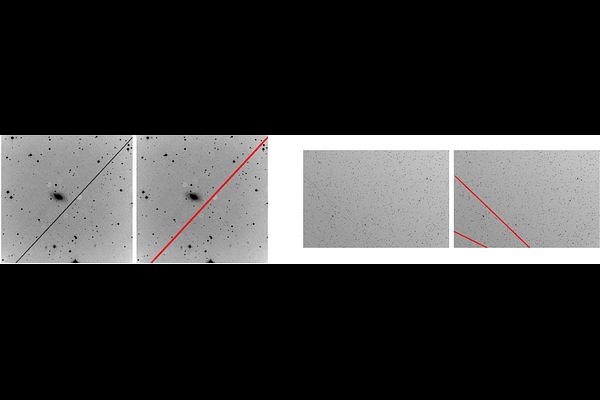
AbstractThe rapid development of mega-constellations in low Earth orbit (LEO) severely impacts ground-based optical astronomical observations. By combining WorldWide Telescope (WWT) simulations with 2019 and 2023 observational data from the Xinglong Observatory 80-cm telescope and 2023 data from the Mini-SiTian (MST), we find that satellite visibility increases with deployment, particularly during the summer. For the 80-cm telescope, the fraction of images containing satellite trails increased from an average of 0.34% in 2019 to 0.7% in 2023; meanwhile, for the MST in 2023, the fraction rose from 5% in January to 12% by December, peaking at 19% in the summer. Through stratified analysis of solar elevation and local time, we find that observations during twilight and summer are particularly susceptible to satellite trail interference. Photometric analysis reveals that the interference intensity increases for fainter sources and those closer to the trails. Furthermore, a comparative analysis across different seeing conditions shows that the deviation of median standardized residuals (σ) is significantly greater under poor seeing than under good seeing conditions.