Stopover Population Estimate and Migration Ecology of Red Knots C. c. rufa at Delaware Bay, USA, 2025

Stopover Population Estimate and Migration Ecology of Red Knots C. c. rufa at Delaware Bay, USA, 2025
Lyons, J. E.
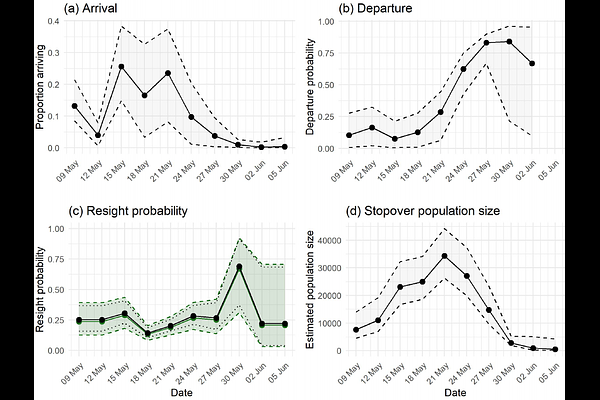
AbstractRed Knots (Calidris canutus rufa) rely on Atlantic horseshoe crab (Limulus polyphemus) eggs in the Delaware Bay to refuel during northward migration. Intensive harvest of horseshoe crabs in the 1990s contributed to declines in Red Knot numbers. In 2013, the Atlantic States Marine Fisheries Commission adopted an Adaptive Resource Management (ARM) framework to balance sustainable horseshoe crab harvest with ecosystem integrity and Red Knot recovery, requiring annual stopover population estimates. We estimated the 2025 passage population of Red Knots at Delaware Bay using a Bayesian analysis of a Jolly-Seber mark-resight model which accounts for population turnover and imperfect detection. We also evaluated change in migration timing between 2011 and 2025 with model-derived estimates of arrival at the Delaware Bay each year. The 2025 passage population was 54,043 individuals (95% credible interval: 47,926-61,928), an increase of approximately 17% over 2024 and only the second year since 2011 to exceed 50,000 individuals. Despite the increase, overlapping credible intervals across years indicate a stable stopover population. Migration timing has remained consistent, with 50% of the population typically arriving by 18 May and no evidence of advancement since 2011. These findings provide meaningful input for the ARM framework, supporting sustainable harvest of horseshoe crabs while maintaining adequate foraging opportunities for Red Knots and other shorebirds.