Migration Traps as Variability Attractors: Optical/UV Signatures of Embedded Stellar-Mass Black Holes in Active Galactic Nucleus Disks

Migration Traps as Variability Attractors: Optical/UV Signatures of Embedded Stellar-Mass Black Holes in Active Galactic Nucleus Disks
Jing-Tong Xing, Tong Liu, Mouyuan Sun, Ya-Ping Li, Shuying Zhou, Zhen-Yi Cai, Da-Bin Lin, Jian-Min Wang
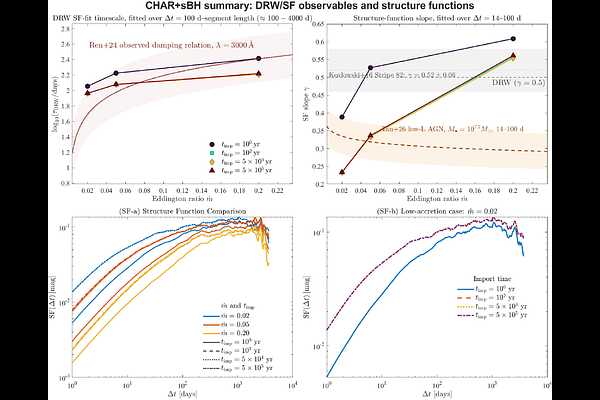
AbstractWe investigate whether embedded stellar-mass black holes (sBHs) in active galactic nucleus (AGN) disks can leave observable optical/UV variability signatures through migration-trap-driven magnetic heating. This mechanism operates when sBHs migrating toward torque-balance radii pile up near migration traps, triggering localized, stochastic magnetic reconnection that heats the disk atmosphere. It is potentially important because it provides a physical source of non-coronal disk heating and directly links optical/UV continuum variability to otherwise hidden compact-object populations. By coupling a one-dimensional sBH population synthesis model with a corona-heated accretion-disk reprocessing variability framework, we show that migration traps concentrate sBHs at preferred radii and generate localized, stochastic reconnection heating. The resulting heating is self-regulated: sBH pile-ups enhance the reconnection rate, while gap opening reduces the local gas density and partially suppresses the reconnection power. This heating produces excess short-timescale optical/UV variability, flattened short-term structure functions, and deviations from the standard $τ\proptoλ^{4/3}$ lag-wavelength relation, which describes the time delay between variability at different wavelengths for a standard thin accretion disk. These signatures are strongest at low-to-moderate Eddington ratios, and related observations could provide indirect evidence for embedded compact-object populations in AGN disks.