A Scaling Relation of LRDs between Broad H$α$ and Bolometric Luminosities: Enhanced Broad H$α$ Emission Relative to Low-$z$ Type 1 AGN

A Scaling Relation of LRDs between Broad H$α$ and Bolometric Luminosities: Enhanced Broad H$α$ Emission Relative to Low-$z$ Type 1 AGN
Hiroto Yanagisawa, Masami Ouchi, Tomokazu Kiyota, Yuta Kageura, Makoto Ando, Yuichi Harikane, Minami Nakane, Yoshiaki Ono, Yui Takeda
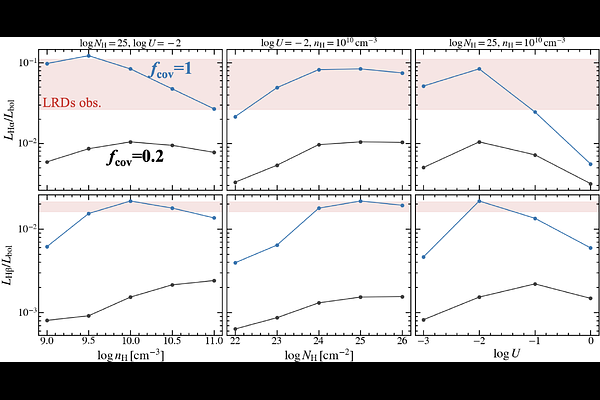
AbstractWe investigate the demography of little red dots (LRDs) using 37 objects at $z\sim3$-$7$ with JWST/NIRSpec PRISM and grating spectra compiled from various JWST programs. We focus on spectroscopic quantities of the broad H$α$ luminosity $L_\mathrm{Hα,broad}$ (and the broad H$β$ luminosity $L_\mathrm{Hβ,broad}$ where available) and the bolometric luminosity $L_\mathrm{bol}$ represented by modified blackbody emission, avoiding quantities contaminated by host-galaxy emission (e.g., total H$α$ luminosity). We identifiy a tight scaling relation between $L_\mathrm{Hα,broad}$ and $L_\mathrm{bol}$, supporting the interpretation that these emissions are primarily powered by the central engine. Interestingly, the $L_\mathrm{Hα,broad}$-$L_\mathrm{bol}$ scaling relation of LRDs is enhanced by a factor of $\sim40$ in $L_\mathrm{Hα,broad}$ relative to that of low-$z$ Type 1 AGN. A similar trend is found in the $L_\mathrm{Hβ,broad}$-$L_\mathrm{bol}$ relation, although the enhancement in $L_\mathrm{Hβ,broad}$ is smaller, only by a factor of $\sim10$. We explore the physical origin of these enhancements and find that \textsc{Cloudy} photoionization modeling within the classic locally optimally-emitting cloud (LOC) framework can explain them through an increase in the covering factor from $\sim20$\% (Type 1 AGN) to $\sim100$\% (LRDs), together with an increase in the hydrogen column density from $N_\mathrm{H}\sim10^{23}\,\mathrm{cm}^{-2}$ to $\gtrsim10^{24}\,\mathrm{cm}^{-2}$, with a preferred gas density of $\sim10^{10}\,\mathrm{cm}^{-3}$, successfully reproducing the modified blackbody emission. Such a nearly unity covering factor without requiring a gas density increase may result from a significant increase in the BLR filling factor or size, corresponding to a ``stuffed BLR" or ``giant BLR," respectively.