Coordinated expansion of CD163⁺ monocytes and immature CD177⁺ neutrophils marks severe neurotoxicity after CD19 CAR T cell therapy

Coordinated expansion of CD163⁺ monocytes and immature CD177⁺ neutrophils marks severe neurotoxicity after CD19 CAR T cell therapy
Chour, T.; Poole, N.; MacMillian, H.; Burleigh, K.; Glass, D. R.; Liang, E. C.; Basom, R.; Webb-Robertson, B.-J.; Stratton, K.; Gratz, D.; Long, A. N.; Elz, A. E.; Huang, J. J.; Hirayama, A.; Riddell, S. R.; Gauthier, J.; Gustafson, H. H.; Newell, E. W.; Simon, S.
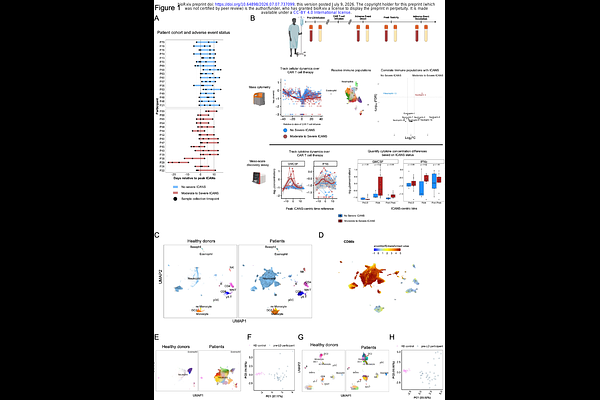
AbstractImmune effector cell-associated neurotoxicity syndrome (ICANS) is a major complication after CAR T cell therapy, but its underlying mechanisms remain poorly understood. We performed longitudinal immune profiling of paired whole blood and serum samples from patients with relapsed or refractory diffuse large B cell lymphoma (DLBCL) treated with CD19 CAR T cells. At peak neurotoxicity, high-dimensional mass cytometry and serum proteomics identified the expansion of CD163 monocytes and immature CD10lowCD101low neutrophils correlated with elevated serum ST2 and IL-2RA concentrations. Integrative immune module analysis identified these features among the strongest predictors of ICANS severity. Independent single-cell transcriptomic profiling validated the emergence of immunoregulatory CD163 monocytes and identified CD177 as a biomarker of ICANS-associated immature neutrophils. Together, these findings reveal a coordinated myeloid inflammatory network associated with ICANS and nominate candidate biomarkers and therapeutic targets for improving the safety of CAR T cell therapy. Significance: We demonstrate that immunoregulatory CD163+ monocytes and immature, activated CD177hiCD10lowCD101low neutrophils emerge in patients with moderate to severe ICANS at peak toxicity following CD19 CAR T cell therapy. These findings identify an uncharacterized myeloid network potentially contributing towards ICANS pathogenesis.