Tumor-derived stearic acid induces macrophage Egr2 signaling to suppress anti-tumor immunity in breast cancer

Tumor-derived stearic acid induces macrophage Egr2 signaling to suppress anti-tumor immunity in breast cancer
Ning, Y.; Wu, C.; Phuyal, S.; Hu, X.; Li, H.; Mitchell, R.; Yan, J.; Ding, C.
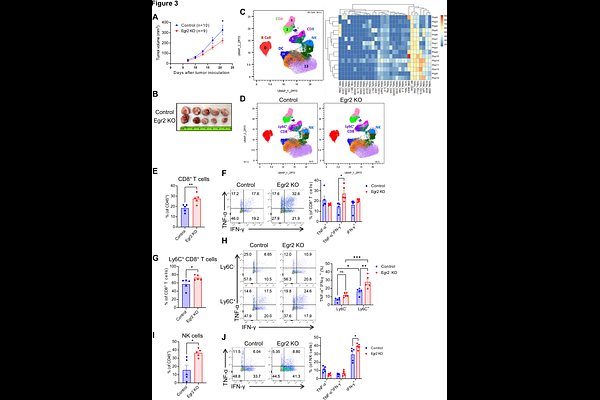
AbstractMacrophages in breast cancer are highly heterogeneous and targeting both tissue-resident and bone marrow-derived macrophages represents a high-potential strategy in breast cancer immunotherapy. Here we showed that early growth response 2 (Egr2) was highly expressed in mammary tissue macrophages and recruited macrophages upon tumor progression. Depletion of Egr2 in myeloid cells significantly decreased the immunosuppressive function of polarized M2-like macrophages and TAMs. Tumor progression was delayed in myeloid cell Egr2 knockout mice, which was associated with enhanced function of effector CD8+ T cells and NK cells. Mechanistically, we showed that retinol and nicotinamide metabolism in TAMs were impaired after Egr2 depletion. Further, tumor cell-derived stearic acid (SA) was identified as an important fatty acid inducing Egr2 expression. SA stimulation induced macrophage-mediated immunosuppression in an Egr2 dependent manner. Addition of oleic acid (OA) uniquely repressed SA-induced Egr2 expression and immunosuppressive activity in macrophages. Our study thus uncovers a novel SA-Egr2 pathway driving macrophage immunosuppression and novel molecular mechanism of OA mediated anti-tumor effect.