Traditional Physical Practice Participation and Vision-Related Quality of Life in Adolescents: The Serial Mediating Roles of Exercise Self-Efficacy and Visual Function Anomalies

Traditional Physical Practice Participation and Vision-Related Quality of Life in Adolescents: The Serial Mediating Roles of Exercise Self-Efficacy and Visual Function Anomalies
Zhang, X.; Liu, Z.; Long, J.
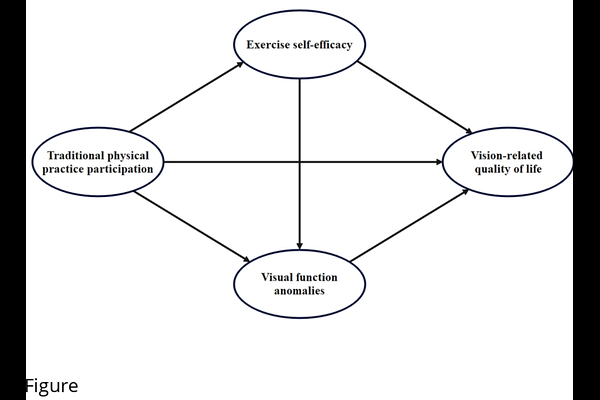
AbstractPurpose: This study examined the association between traditional physical practice participation and vision-related quality of life among junior secondary school students and tested the mediating roles of exercise self-efficacy and visual function anomalies within a serial mediation framework. Methods: A four-wave time-lagged survey was conducted among 1,579 students in Grades 7-9 from schools implementing traditional physical practice activities. Variables were assessed at two-week intervals. Mediation effects were tested using the bias-corrected percentile bootstrap method with 5,000 resamples. Results: The total effect of traditional physical practice participation on vision-related quality of life was significant ({beta} = 0.591, p < .001). After including the mediators, the direct effect remained significant ({beta} = 0.404, 95% CI [0.348, 0.457]), accounting for 68.36% of the total effect. The total indirect effect was significant ({beta} = 0.187, 95% CI [0.160, 0.218]), representing 31.64% of the total effect. The indirect effect via exercise self-efficacy was significant ({beta} = 0.088, 95% CI [0.068, 0.112], 14.89%), as was the indirect effect via visual function anomalies ({beta} = 0.065, 95% CI [0.048, 0.086], 11.00%). The serial mediation pathway through exercise self-efficacy and visual function anomalies was also significant ({beta} = 0.034, 95% CI [0.025, 0.045], 5.75%). All confidence intervals excluded zero, supporting partial mediation. Conclusion: Traditional physical practice participation was associated with vision-related quality of life both directly and indirectly through exercise self-efficacy and visual function anomalies, including a significant serial mediation pathway. The findings highlight the combined psychological and functional mechanisms underlying adolescents vision-related quality of life.