First Detection of Extensive Air Showers Using a Small-Aperture Fluorescence Telescope

First Detection of Extensive Air Showers Using a Small-Aperture Fluorescence Telescope
M. Zotov, A. Trusov, P. Klimov, K. Asatryan, A. Belov, G. Gabaryan, V. Kudryavtsev, A. Murashov
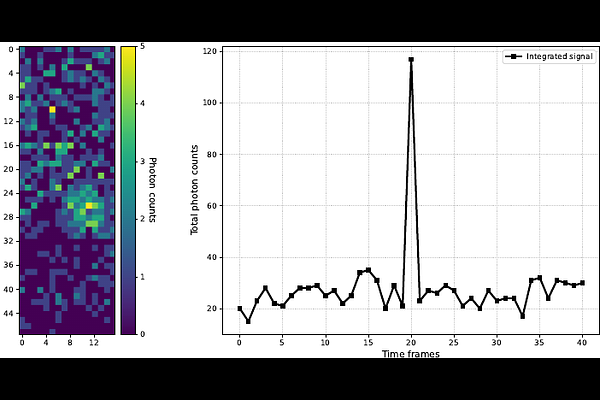
AbstractWe report on the successful detection of extensive air showers (EAS) generated by ultra-high-energy cosmic rays using a small-aperture fluorescence telescope (FT) deployed at the Mount Aragats high-altitude research station. The instrument is equipped with a 25 cm diameter Fresnel lens and operates with a 2.625 $μ$s time resolution. To our knowledge, this represents the first-ever observation of EAS achieved with an FT of such a compact aperture. To isolate shower events from the observational data, we implemented two independent event selection pipelines: a conventional cut-based analysis and a deep learning approach utilizing neural networks. Both algorithms successfully identified over 15 high-confidence EAS tracks from data acquired during clear, moonless nights. We present selected event topologies and detail the background rejection methodology employed to discriminate true shower tracks from spurious focal-plane signals mimicking EAS signatures. These results provide an important proof-of-concept for the advancement of fluorescence detection techniques, demonstrating their viability for forthcoming ground-based and space-borne missions. Future efforts will focus on primary energy reconstruction utilizing a previously developed neural-network framework.