Effect of Ethyl Methane Sulfonate Mutagenesis on Phenological, Yield-Related andYield Traits in Cowpea (Vigna unguiculata (L.) Walp)

Effect of Ethyl Methane Sulfonate Mutagenesis on Phenological, Yield-Related andYield Traits in Cowpea (Vigna unguiculata (L.) Walp)
MENSAH, H. K.; Nortey, R. A. K.; Asante, I. K.; Oppong-Adjei, F.
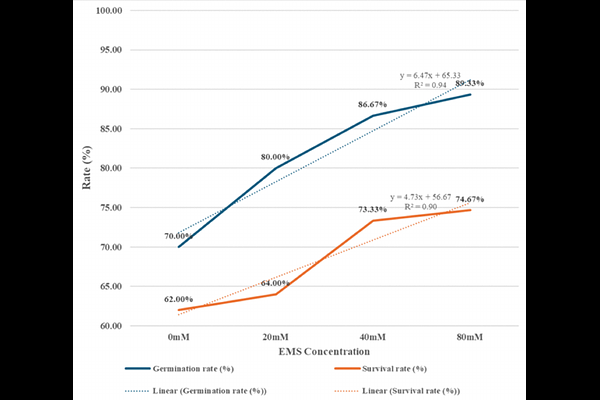
AbstractThis study investigated the mutagenic effects of ethyl methane sulfonate (EMS) on the M0; generation of cowpea (Vigna unguiculata (L.) Walp.) cultivar 'Wang Kae'. A total of 275 M0; seeds were treated with EMS concentrations of 20 mM, 40 mM, and 80 mM (75 seeds per treatment) by soaking for six hours, while 50 untreated seeds served as the control (0 mM). Phenological, yield-related and yield traits were recorded, and data were analysed using Jamovi 2.7.15 and JASP 0.95.4.0 through one-way ANOVA with post hoc contrast, principal component biplot, and cluster analyses. No optimal mutagenic concentration (LD50) was identified. Seed germination and seedling survival rates increased with increasing EMS concentration, ranging from 70.00% and 62.00% in the control (0 mM) to 89.33% and 74.67% at 80 mM, following the trend 0 mM < 20 mM < 40 mM < 80 mM. Significant differences (P < 0.05) were observed among treatments for all phenological traits, pod length, locule number, seed traits, and yield per plant. Yield was significantly higher (P = 0.047) at 20 mM (61.19 {+/-} 3.34 g) compared to the control. Contrast analysis identified genotypes B33 and D56 as the most productive mutants, with yields of 125.44 g and 111.85 g, respectively. Principal component analysis extracted eighteen components, with the first four cumulatively explaining 50.60% of total variation. Biplot analysis of PC1 and PC2 captured all phenological traits, key seed traits, and yield attributes, highlighting the superior performance of B33 and D56. Cluster analysis partitioned the 190 genotypes into six groups, with B33 and D56 constituting distinct clusters. EMS mutagenesis effectively induced heritable phenotypic variation, with putative superior genotypes identified for advancement to M2; and evaluation in replicated multi-environment trials toward the development of farmer- and consumer-preferred cowpea varieties.