PRODIGE -- envelope to disk with NOEMA VIII. Sulfur oxides trace a shock caused by a streamer in the inner envelope of a protostar

PRODIGE -- envelope to disk with NOEMA VIII. Sulfur oxides trace a shock caused by a streamer in the inner envelope of a protostar
María Teresa Valdivia-Mena, Jaime E. Pineda, Caroline Gieser, Paola Caselli, Dominique M. Segura-Cox, Yuxin Lin, María José Maureira, Tien-Hao Hsieh, Laura A. Busch, Ana Lopez-Sepulcre, Laure Bouscasse, Dmitry Semenov, Asunción Fuente, Nichol Cunningham, Thomas Henning, Julián J. Miranzo-Pastor, Yu-Ru Chou, Roberto Neri, Izaskun Jimenez-Serra, Edwige Chapillon, Stephane Guilloteau, Felipe Alves, Mario Tafalla, Anne Dutrey, Riccardo Franceschi, Sierk van Terwisga, Kamber Schwarz
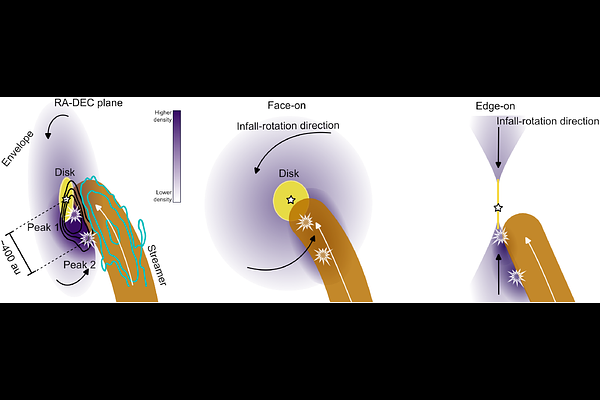
Abstract(Abridged) Recently, streamers have been observed causing shocks at the outer edge of protoplanetary disks. The study of sulfur-bearing species can help us to understand the physical and chemical changes caused by infalling streamers toward their landing positions. We study the physical properties traced by SO$_2$ and SO toward the Class I protostar Per-emb 50, which is possibly related to the streamer infalling toward its disk. We present new NOEMA A-array observations as part of the large program "Protostars and Disks: Global Evolution" (PRODIGE). We analyzed the morphology of SO$_2$ and SO, and complement our interpretations with additional H_$2$CO and CO data from the same program. We compared the SO$_2$ and SO morphology with an infalling-rotating model. We applied Bayesian model selection to the brightest SO$_2$ line to disentangle the different kinematic components traced by this molecule. We used Local Thermodynamic Equilibrium (LTE) and non-LTE analyses to determine the temperature and density of the SO$_2$ emission. There are two separate peaks of SO$_2$ emission offset toward the southwest of Per-emb 50, one brighter (peak 1) at about 180 au from the protostar, and a weaker one (peak 2) at about 400 au. Peak 2 is blueshifted with respect to an infalling-rotating envelope. We propose that this peak is caused by the shock between the inner envelope and the streamer. Peak 1 is consistent with the expected envelope motion, and could thus be caused by shocks at the disk-envelope interface, but potential streamer influence cannot be neglected. Both peaks show abundance ratios consistent with a low velocity shock ($\sim 3-4$ \kms) when compared with shock models. Streamers can affect the physical and chemical structure of both disks and envelopes, suggesting that streamers can play an important role in shaping both structures in the embedded stages of star formation.