Phase-dependent chemistry of WASP-43 b revealed with a suite of one-, two-, and three-dimensional models

Phase-dependent chemistry of WASP-43 b revealed with a suite of one-, two-, and three-dimensional models
Robin Baeyens, Julianne I. Moses, Jasmina Blecic, Elspeth K. H. Lee, Lucas Teinturier, Shang-Min Tsai, Jeehyun Yang, Jingxuan Yang, Ludmila Carone, Renyu Hu, Sven Kiefer, Anjali A. A. Piette, Taylor J. Bell, Nicolas Crouzet, Ian Dobbs-Dixon, Christiane Helling, Nicolas Iro, Dominic Samra, Olivia Venot, Jean-Michel Désert
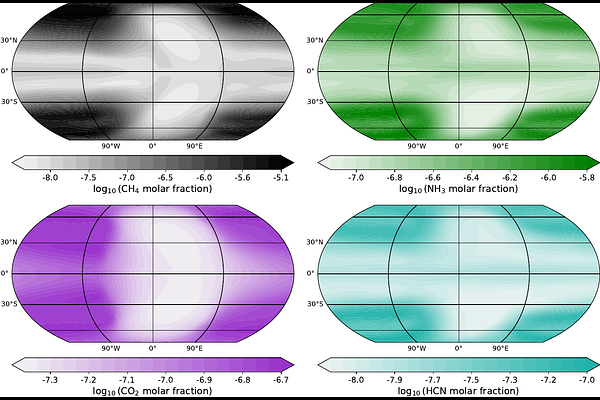
AbstractOur goal is to investigate the chemistry of the hot Jupiter WASP-43 b in detail using theoretical models, considering the constraints of the James Webb Space Telescope MIRI phase curve. With a suite of pseudo-two-dimensional and three-dimensional photochemical models, we simulate the composition of WASP-43 b in various configurations, and compare them with atmospheric retrieval models. We confirm that disequilibrium chemistry in our theoretical models reduces the methane concentration on the planet night side for wind jet speeds > 500 m/s. Varying the metallicity in the models induces large changes in the CO$_2$ and SO$_2$ concentrations, with SO$_2$ producing mid-infrared absorption features in synthetic emission spectra of the night side at atmospheric metallicities > 10x solar. Our models provide evidence for pole-to-equator circulation enhancing the CH$_4$, NH$_3$, and HCN abundances, which is nonetheless insufficient for detectable spectral features. Finally, we show that H$_2$O, CO, and CO$_2$ are robustly modeled, but species affected by photochemistry are more sensitive to model-specific assumptions and pathways. We conclude that horizontal quenching is the prime mechanism that explains the non-detection of methane in the MIRI phase-curve of WASP-43 b. This mechanism requires only moderate wind speeds and is operative at various thermal structures and atmospheric metallicities. Furthermore, coupled carbon-sulfur chemistry leads to an additional decrease in methane compared to previous models in the literature that did not contain sulfur chemistry. We do not favor a high metallicity as it would have led to observable SO$_2$ features in the MIRI spectra. Our study shows that phase-dependent photochemistry models are essential tools in the interpretation of hot-Jupiter phase curves, but benchmarking is needed to improve the accuracy of photochemical models in the future.