Multi-dimensional, time-dependent approximate NLTE unified model atmospheres with winds for hot, massive stars

Multi-dimensional, time-dependent approximate NLTE unified model atmospheres with winds for hot, massive stars
Dwaipayan Debnath, Jon O. Sundqvist, Nicolas Moens, Luka G. Poniatowski, Cassandra Van der Sijpt, Andreas A. C. Sander
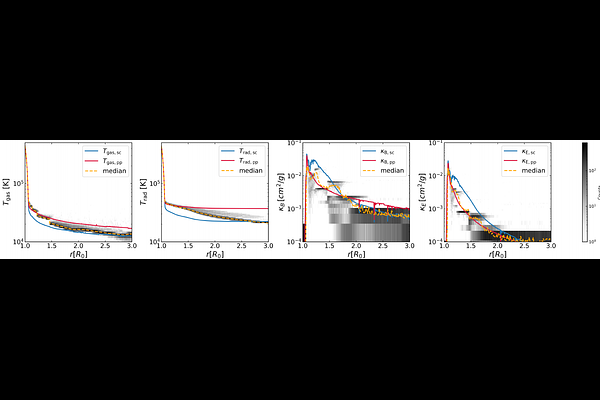
AbstractMulti-dimensional unified model atmospheres with winds of massive stars have so far been studied under the assumption of equal flux, Planck, and energy weighted mean opacities, which effectively means these models have been in local thermodynamic equilibrium (LTE). Although LTE may be a valid approximation in deeper atmospheric layers, it breaks down in the extended outflowing parts. As such, the opacities governing the heating and cooling of the gas are neither the same nor equal to flux-mean opacity in those regions. We present an approximate NLTE procedure that accounts for scattering in the computation of energy and Planck-mean opacity from a multitude of spectral lines in an accelerating medium. The formalism evaluates the opacities using Sobolev escape probabilities and effective thermalization parameters from a line database consisting of ~4 million spectral lines. RHD simulations are calculated as before with a hybrid opacity scheme combining Rosseland means with line opacities in an accelerating medium. Due to their high velocity dispersion, upon interaction, they produce localized shock fronts with the gas temperature exceeding the photon temperature. Due to improved treatment of heating and cooling in outflowing parts, the radiation and gas temperatures in the wind are no longer the same, as was the case in previous multi-dimensional simulations. Instead, gas gets heated at shock fronts, but due to strong radiative cooling remains localized. The net result is a multi-component wind structure not only in density and velocity, but also in temperature. This likely has important consequences for the formation and interpretation of observed O-type star wind spectra.