Revised nomenclature of avian quadrate morphology and a detailed survey of clade-specific anatomical features

Revised nomenclature of avian quadrate morphology and a detailed survey of clade-specific anatomical features
Kuo, P.-C.; Benson, R.; Field, D. J.
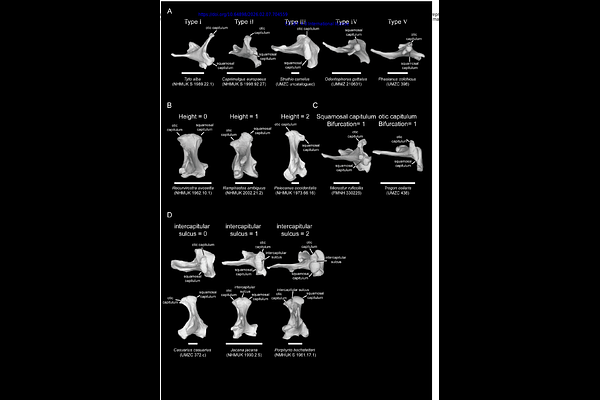
AbstractIn birds, the quadrate bone serves as a hinge articulating with the lower jaw and the skull, playing an important mechanical role in the feeding apparatus. Avian cranial kinesis is dependent on the streptostylic quadrate transferring force from the adductor muscles at the back of the skull toward the beak, as part of a four-bar mechanical linkage to elevate and depress the bill. The complex morphology of the bird quadrate has led to authors adopting a range of alternative terminologies to describe the same anatomical structures and character states, impeding clarity of communication and presenting a barrier to progress in our understanding of the evolution of this important component of the avian feeding apparatus. Here, we reconcile terminological discord among previous studies on avian quadrate morphology and propose a stable nomenclature for future work. To characterise the considerable variation in quadrate form across crown bird diversity, we present an extensive anatomical atlas of the avian quadrate and summarise major patterns of quadrate morphological variation across extant avian phylogeny. In addition, we investigate macroevolutionary patterns in avian quadrate morphology, incorporating comparisons of crown birds and Late Cretaceous near-crown stem birds. We demonstrate that quadrate characters are useful for diagnosing a range of major avian subclades, and suggest that numerous distinctive features are likely to be associated with important biomechanical consequences. This investigation has implications for resolving the unsettled phylogenetic relationships of extinct bird clades such as Pelagornithidae and Gastornithiformes, as well as controversial relationships within several extant groups.