AESTRA II: Generative Spectral Modeling of the Sun as a Star for Precise Radial Velocities

AESTRA II: Generative Spectral Modeling of the Sun as a Star for Precise Radial Velocities
Yan Liang, Joshua N. Winn, Peter Melchior, Sicong Lu, Quang H. Tran
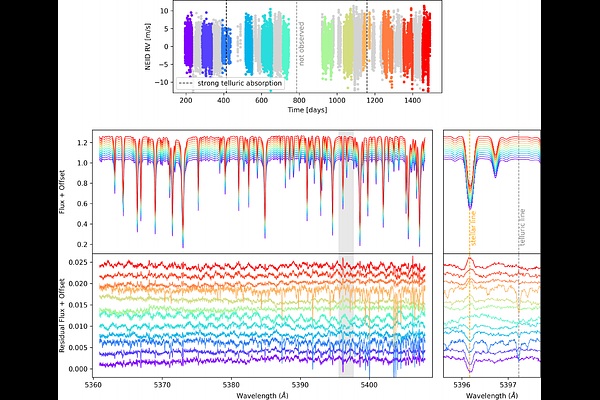
AbstractThe detection of Earth analogs with extreme-precision radial velocities (EPRVs) is limited by spectral variability from stellar activity, telluric absorption, and instrumental systematics. We apply AESTRA, a generative spectrum modeling framework, to NEID Sun-as-a-star observations. AESTRA empirically decomposes the spectra into stellar line-shape variability, micro-telluric absorption, and continuum variability without external atmospheric or stellar templates. After removing the learned telluric and continuum components, we train a low-dimensional representation of the spectrum to infer activity-driven apparent RVs jointly with candidate Doppler signals. We evaluate the method with 500 single-planet injection-recovery tests spanning periods of 2.5 to 400 days and semi-amplitudes of K = 0.1 to 0.7 m s^-1, calibrating the detection criterion to yield zero spurious detections. At this matched confidence level, AESTRA recovers 238 injected planets, including 13 with K < 0.3 m s^-1, whereas traditional CCF-based activity-indicator detrending recovers 9 planets and none below K = 0.5 m s^-1.