Sustainability as a design parameter in the early development of the Wide-field Spectroscopic Telescope

Sustainability as a design parameter in the early development of the Wide-field Spectroscopic Telescope
L. Fréour, E. Burtin, R. Bacon, B. Ziegler, S. Randich, A. Pecontal, P. M. Weilbacher, C. Cudennec, D. Buffat, S. D'Auria, A. Meoli, L. P. Cassarà, P. Dierickx, V. Mainieri, P. Franzetti, D. Lee
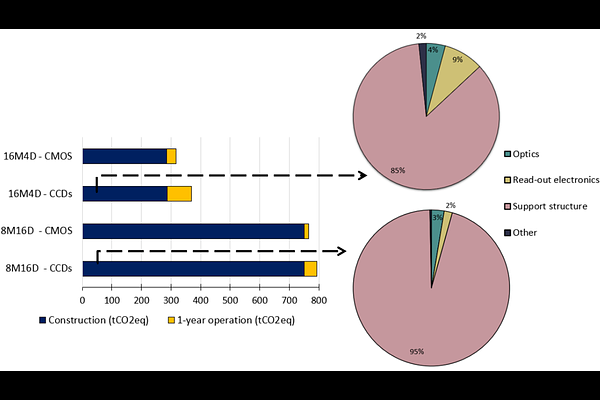
AbstractThe proposed Wide-field Spectroscopic Telescope, a next-generation telescope facility with a 12-meter primary mirror that may be operational in the 2040s, is integrating sustainable considerations from the early design stage. Our preliminary analysis identifies two primary sources of environmental impact that can be mitigated during the design process. First, we are conducting a life-cycle assessment (LCA) to quantify the environmental impact of the ~250 spectrographs and the detector cooling systems across the telescope's three instruments, from construction through operation. The carbon footprint estimated through this LCA has been included as a trade-off parameter in the design choices. Second, the WST is expected to produce 1-3 PB/year, requiring careful evaluation of data processing and storage strategies. We explore approaches to monitoring and reducing the carbon footprint associated with data management. Bringing environmental factors into the design process from the start gives us the chance to weigh sustainability alongside scientific performance and cost. By treating the carbon footprint as a core design consideration, we aim to make progress toward more responsible astronomy.