Host-specific and common core microbiota in adult butterflies across continents

Host-specific and common core microbiota in adult butterflies across continents
Weinhold, A.; Pinos, A.; Correa-Carmona, Y.; Holzmann, K. L.; Alonso-Alonso, P.; Yon, F.; Steffan-Dewenter, I.; Peters, M. K.; Brehm, G.; Keller, A.
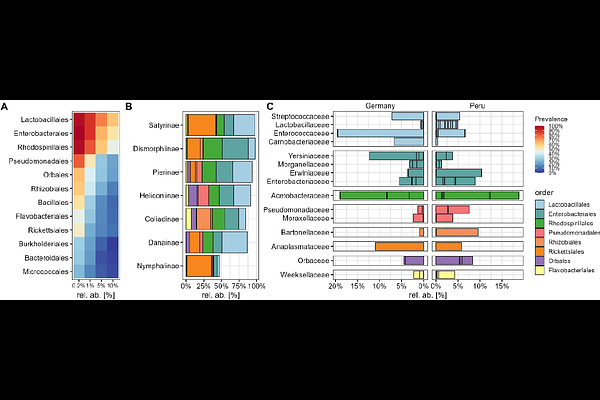
AbstractThe assembly of host-specific microbiota is critical for health and functioning of many insect pollinators. While social pollinators maintain core microbiota through social transmissions, the factors driving microbiota assembly in solitary pollinators remain poorly understood. Lepidoptera are an important group of pollinators, but microbiome research has largely focused on their larval stage, while nectar feeding adults have been widely ignored. Field-based studies of the adult butterfly microbiota are rare and geographically and taxonomically restricted. Here, we characterize the microbiota of adult butterflies from natural environments along elevational and temporal gradients across two continents spanning the Neotropical and Palearctic realms. Microbiota diversity and composition were primarily explained by host taxonomic identity, whereas geographic location and temperature had little effect. We found common core microbiota conserved across seven butterfly subfamilies from temperate and tropical regions, which include lactic acid bacteria (LAB), acetic acid bacteria (AAB), and even some bee-associated taxa. Together, our results demonstrate that host taxonomic identity, rather than environmental drivers, is the dominant force structuring the microbiota of adult butterflies. This highlights that the host-filtering capacity of solitary species has been largely underestimated, challenging previous assumptions that the microbiota of this important pollinator group is primarily environmentally driven and of limited functional significance.