Static masks and saccadic velocity profile jointly reduce perceived motion: Evidence from simulated saccades

Static masks and saccadic velocity profile jointly reduce perceived motion: Evidence from simulated saccades
Noerenberg, W.; Schweitzer, R.; Rolfs, M.
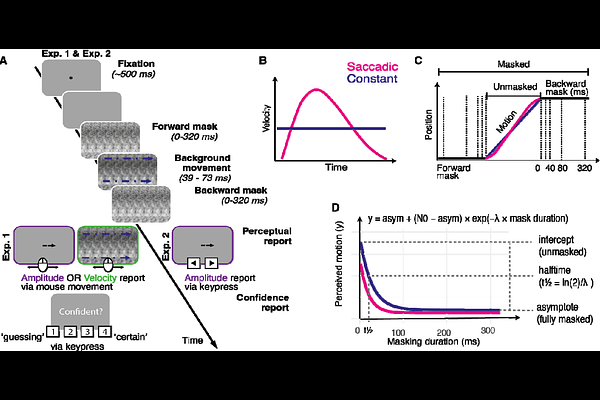
AbstractSaccadic eye movements sweep the visual scene across the retina, yet the resulting motion is rarely perceived. Visual factors alone, such as the presence of static pre- and post-saccadic images, can attenuate motion perception, suggesting a masking of the motion signal during early visual processing. Here, we isolated the visual component of this reduction in motion perception using simulated saccades presented to fixating observers. Across two experiments, we manipulated motion amplitude (6-18 dva), duration, and velocity profile and measured perceived amplitude and velocity at varying masking durations. Visual masking strongly reduced perceived motion amplitude and velocity, with short halftimes (~sim;15 ms) that were largely invariant across saccade amplitudes. Critically, motion following a naturalistic saccadic velocity profile was perceived as smaller and slower than constant-velocity motion matched in amplitude and duration, even without explicit masking. This additional reduction increased with both amplitude and duration. These results show that visual mechanisms alone can account for substantial motion reduction across a large range of amplitudes and demonstrate a partially separable contribution of the saccadic velocity profile, suggesting that the temporal structure of retinal motion itself supports perceptual continuity across eye movements.