Route of Adenovirus Type 5-Vectored Influenza Vaccination Shapes Systemic and Mucosal Immunity in a Maternal-Neonatal Pig Model

Route of Adenovirus Type 5-Vectored Influenza Vaccination Shapes Systemic and Mucosal Immunity in a Maternal-Neonatal Pig Model
Langel, S. N.; Byrne, J. J.; Leal, D.; Williams, A.; Sirisereewan, C.; Meritet, D.; Rahe, M. C.; Watanabe, T. T. N.; Compton, S.; Rajao, D.; Ferreira, J. B.; Tucker, S.; Crisci, E.
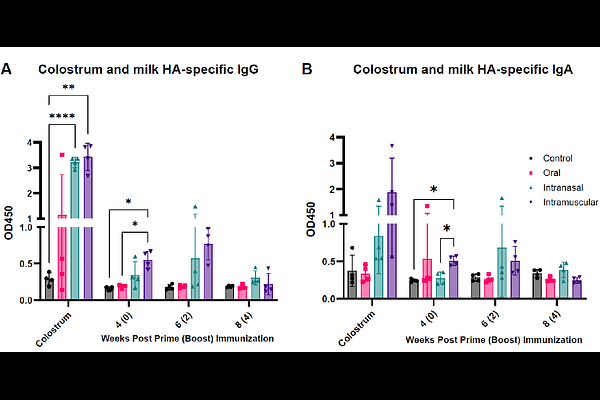
AbstractInfluenza A virus can cause severe complications in pregnant women and infants, yet no influenza vaccines are approved for infants younger than six months. To address this, novel maternal vaccination strategies are needed to increase global access and coverage in these vulnerable populations. This study evaluated a hemagglutinin (HA) A/California/2009 (H1N1)-based human adenovirus 5 (huAd5) vector vaccine, adjuvanted with a TLR3 agonist, for its ability to induce influenza-specific passive immunity from pregnant and lactating pigs to their piglets following different immunization routes. Influenza naive pregnant dams were vaccinated via oral, intranasal (IN), or intramuscular (IM) routes three weeks prepartum and boosted four weeks later. Serum, colostrum and milk samples were collected longitudinally to assess HA-specific antibody induced by vaccination. H1N1-Ca/09 neutralizing antibodies were evaluated in serum and IFN{gamma} producing cells were assessed in blood, spleen and lymph node cells. IN and IM routes elicited robust serum HA-specific antibody responses when compared to control animals at one- and four-weeks post-boost, whereas the oral route resulted in poor antibody induction across all samples tested. Piglets nursing from IN and IM vaccinated dams showed a significantly higher level of HA-specific antibodies in serum at 2-3 weeks post-partum compared to control piglets. Notably, IN immunized dams and their piglets showed significantly elevated influenza neutralizing antibodies compared to controls. This work demonstrated that both IN and IM immunization with a huAd5-vectored vaccine robustly induced maternal influenza-specific immunity that supported passive transfer to nursing piglets, with IN immunization resulting in superior transfer of neutralizing antibodies.