Rice Jumonji706 confers the photoperiod sensitivity in rice by distinct regulation of short-day and long-day flowering time regulatory pathways.

Rice Jumonji706 confers the photoperiod sensitivity in rice by distinct regulation of short-day and long-day flowering time regulatory pathways.
Nagalla, A. D. D.; Morita, R.; Ichida, H.; Hayashi, Y.; Shirakawa, Y.; Ichinose, K.; Sato, T.; Toriyama, K.; Abe, T.
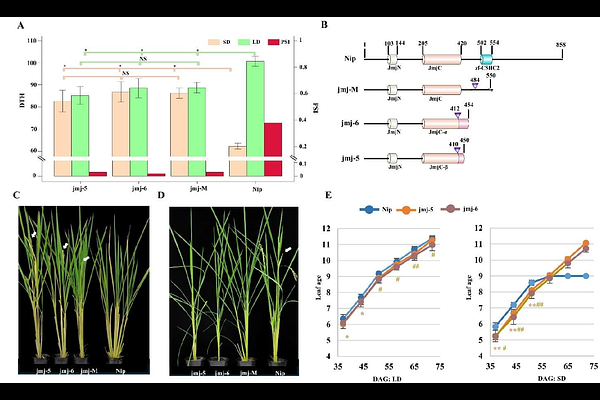
AbstractPhotoperiod sensitivity (PS) is a key biological response in plants as they adapt to specific environments. Rice (Oryza sativa L.) exhibits a clear PS, as it implements critical phase transition decisions based on PS signals. In this study, we identified a novel PS gene, JMJ706, that is expected to deliver photoperiod-related signals to the flowering-time regulatory network in a day-length-dependent manner. The JMJ706 mutants exhibit early flowering under LD and later flowering under SD compared to WT plants. The gene encodes an H3K9me2 demethylase, and under long-day (LD) conditions, its demethylase activity facilitates the expression of Grain number, Plant height, and Heading-date7 (Ghd7). Since Ghd7 is a floral repressor in LD, it promotes the vegetative phase by delaying flowering. Under short-day conditions (SD), H3K9me2 demethylase activity facilitates Early heading-date 1 (Ehd1) expression, and it acts as a floral accelerator by inducing Heading date 3 (Hd3a) and RICE FLOWERING LOCUS T 1 (RFT1). Furthermore, we propose that the daylength-dependent promotion of target genes (Ghd7 and Ehd1) occurs through demethylation of specific promoter regions at a crucial time window. In addition, JMJ706 may play an important role in regulating plant architecture, including plant height. The natural variation in JMJ706 alleles shows high frequencies across major rice subpopulations, suggesting that JMJ706 could play an important role in the geographical distribution and adaptation of rice cultivars. Our results may add a new layer to the rice flowering-time regulatory pathway, supporting regional adaptation and potential for future breeding.