Effective Field Theory of Large Scale Structure and Newtonian Motion Gauges

Effective Field Theory of Large Scale Structure and Newtonian Motion Gauges
Christian Fidler, Julien Lesgourgues, Antonia Mattes, Azadeh Moradinezhad Dizgah, Simon Neuland
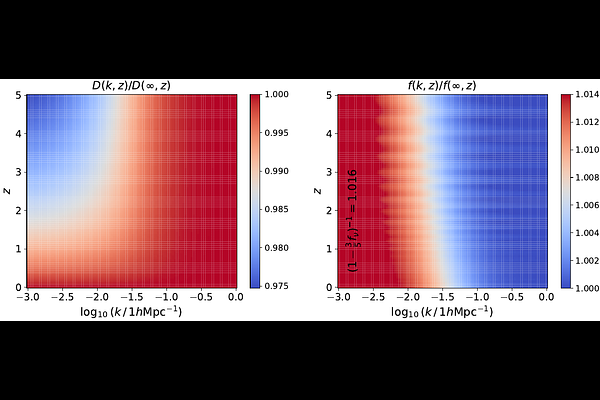
AbstractThe simplest flavor of the Effective Field Theory of Large Scale Structure is based on Newtonian equations and describes the nonlinear matter density and velocity using Einstein-de-Sitter kernels. Even in the presence of massive neutrinos, this has been argued to be sufficient for the analysis of data from Stage-III galaxy surveys. In this paper, we show that there exists a simple way to extend the validity range of this framework to more complex problems with a scale-dependent growth factor, while incorporating linear general relativistic (GR) corrections as well. For a given cosmology, an Einstein-Boltzmann code can find the exact gauge transformation that brings the full linear equations of motion of the clustering matter components into a form where they are identical to Newtonian equations for a self-gravitating fluid with scale-independent growth. Non-linear clustering can be consistently computed in this gauge, and the results can be transformed back to the initial gauge in order to incorporate GR and scale-dependent-growth effects. Redshift-space distortions can also be accounted for with a similar strategy. Our method does not incur any additional computational cost. As a showcase, we apply this method to cosmologies with massive neutrinos. For the real-space one-loop power spectrum, we find that the largest deviation between the accurate and standard methods remains below 0.7% for M_nu<0.30 eV. However, in redshift space, it reaches 1.7% for the one-loop quadrupole spectrum at k=0.3 h/Mpc and z=0, with the largest contribution coming from the effect of the cosmological constant on the growth of the velocity field. Our method could be applied to a much wider range of models with more significant scale-dependent growth, as long as a self-consistency condition evaluated by the Einstein-Boltzmann code (on the smallness of a gauge transformation field) is fulfilled.