Differential drought sensitivity of total and active wheat rhizosphere microbiome during rainfall reduction

Differential drought sensitivity of total and active wheat rhizosphere microbiome during rainfall reduction
Samad, A.; Schmidt, R. L.; Azarbad, H.; Garbeva, P.; Tremblay, J.; Yergeau, e.
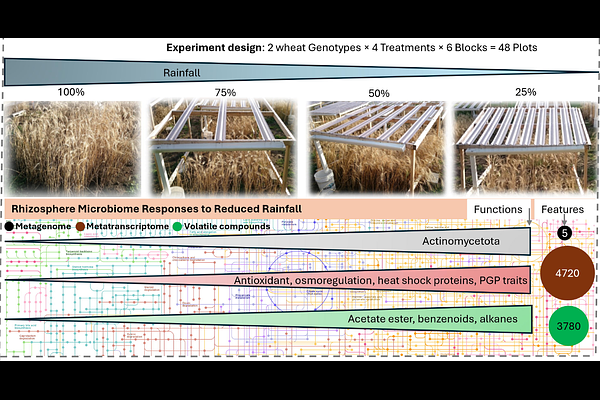
AbstractRoot-associated microorganisms play a pivotal role in helping plants adapt to drought stress. However, the underlying mechanisms of the rhizospheric microbiome under limiting soil moisture remain largely unresolved. Integrating total and active microbiome analyses enables a more accurate interpretation of microbial responses to climate change-associated water stress. We assessed the effect of reduced rainfall on two wheat genotypes, drought-tolerant (DT) and drought-sensitive (DS), using rainout shelters that allowed 100%, 75%, 50%, and 25% of natural precipitation to reach the crop. At the peak of the growing season, rhizosphere samples were collected for metagenomic (MG) and metatranscriptome (MT) sequencing. In parallel, rhizosphere volatile organic compounds (VOCs) were collected and analysed. Differential expression analysis of metatranscriptomic data using metagenomic abundance as a cofactor was performed by comparing all treatments to the 100% precipitation control. Our results demonstrate that particularly oxidative stress-related transcripts intensify in DS as rainfall decreases. Transcriptomic shifts primarily involved upregulation of transcripts associated with antioxidant (catalase, superoxide dismutase), heat shock proteins (Hsp10, Hsp60, DnaK/DnaJ, GroEL, GroES), as well as microbial functions related to osmoregulation, proline and glycine betaine (PutA, PutP, OpuBB), and plant growth-promoting traits such as auxin production, phosphate solubilization. Moreover, volatile organic compound (VOC) emissions differed significantly between the control and drought treatments, with higher emissions, particularly acetates, in the DS genotype than in the DT genotype. Overall, pronounced drought-induced shifts in active microbial functions and VOC emissions indicate high sensitivity and functional plasticity of the active microbiome, whereas the total microbiome remains robust under medium drought.