Rocking around the pheno-clock: bridging vegetation phenology and chronobiology

Rocking around the pheno-clock: bridging vegetation phenology and chronobiology
Bajocco, S.; Ricotta, C.; Bregaglio, S.
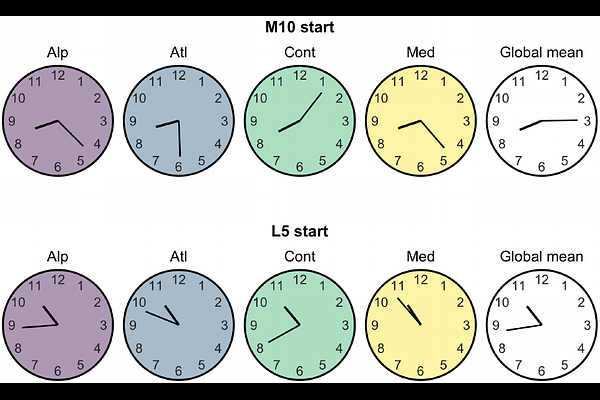
AbstractPlant phenology controls resource acquisition, survival and reproductive success, yet it is still commonly reduced to a limited set of calendar-based metrics, such as discrete dates of budburst or senescence. By contrast, chronobiology quantifies biological rhythms from full activity profiles using metrics that capture timing, regularity and amplitude of rest-activity cycles. Here, we bridge these two perspectives by developing a pheno-clock framework that translates plant phenology into chrono-ecological properties. We applied actigraphy-inspired metrics to multi-year satellite time series of European beech (Fagus sylvatica) forests across their European range. From daily photothermal activity profiles, we derived indices describing the strength, fragmentation and amplitude of annual rest-activity rhythms and related them to classical phenological metrics and regional climate. Our results reveal a marked asymmetry between spring and autumn phenology, indicating that canopy decline is governed by the cumulative organization of annual energy input, whereas canopy activation is dominated by short-term forcing. Across biogeographical regions, beech forests segregate into distinct pheno-chronotypes that differ in the timing and consolidation of rest and activity phases rather than in growing-season length alone. These chrono-ecological patterns suggest that climate filters not only when forests grow, but also how they structure their annual rhythmicity. By importing chronobiology into plant phenology, the pheno-clock framework provides a transferable approach to describe and compare seasonal strategies in plants, opening new avenues to link phenological diversity, functional traits and ecosystem responses to environmental change.