Coupled Dark Energy and Dark Matter for DESI: An Effective Guide to the Phantom Divide

Coupled Dark Energy and Dark Matter for DESI: An Effective Guide to the Phantom Divide
Stefan Antusch, Stephen F. King, Xin Wang
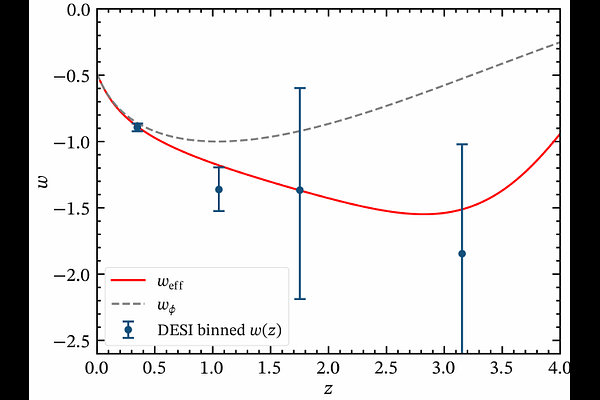
AbstractMotivated by the recent Dark Energy Spectroscopic Instrument (DESI) DR2 preference for dynamical dark energy, we study interacting dark energy models in which a canonical quintessence field couples to cold dark matter through a field-dependent mass $m(φ)$. In such scenarios, the effective equation of state inferred under the assumption of non-interacting dark sectors, $w_{\rm eff}(z)$, can differ from the intrinsic scalar-field equation of state $w_φ(z)$, making an apparent phantom crossing $w_{\rm eff}<-1$ possible without introducing a phantom scalar. We show that a viable realization of this mechanism requires the scalar field to originate from a frozen phase deep in the radiation era, in order for the effective coupling to remain sufficiently suppressed before recombination to evade cosmic microwave background constraints, and for the late-time evolution to become strong enough to reproduce the apparent behavior of $w_{\rm eff}(z)$ preferred by DESI. We identify the general conditions that allow these requirements to be satisfied simultaneously, and present an illustrative phenomenological realization in which $w_{\rm eff}(z)$ evolves from $w_{\rm eff}\approx -1.2$ at $z \approx 1.0$ to $w_{\rm eff}\approx -0.9$ at $z\approx 0.4$. These conditions and requirements serve as a guide for designing future models of this kind which can safely navigate the phantom divide at $w=-1$ in an effective way without phantom fields.