Cylindrical cosmological simulations with StePS

Cylindrical cosmological simulations with StePS
Gábor Rácz, Viola H. Varga, Balázs Pál, István Szapudi, István Csabai, Till Sawala
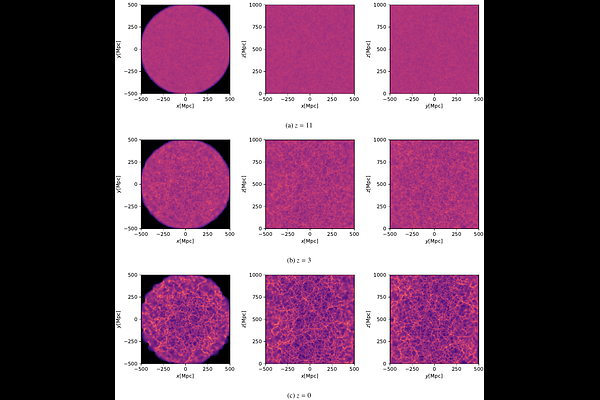
AbstractThe global topology of the Universe can affect the long-range gravitational forces through the boundary conditions. To study non-trivial topologies in detail, simulations that natively adopt such geometries are required. Cosmological $N$-body simulations typically evolve matter in a periodic cubic box. While numerically convenient, this imposes a non-trivial 3-torus topology that affects long-range gravitational forces, potentially biasing large-scale statistics. We introduce a compactified simulation framework that is only periodic along a single axis, while having infinite topology with isotropic boundary conditions towards the perpendicular directions, i.e. an $\mathrm{S}^1\times\mathbb{R}^2$ ("slab") topology. This new simulation geometry is ideal for simulating systems with cylindrical symmetries like filaments or certain anisotropic cosmological models. We compactify comoving space via inverse stereographic projection along the radial direction of a periodic cylinder, and evolve particles with Newtonian dynamics. A smoothly varying spatial and mass resolution with radius suppresses edge artefacts at the free outer boundary. Our implementation in the StePS (STEreographically Projected cosmological Simulations) framework uses a direct $\mathcal{O}(N^2)$ force calculation that maps efficiently to GPUs, and Octree $\mathcal{O}(N \log N)$ force calculation that can be used on large CPU-clusters. The cylindrical domain's topology enables fully self-consistent simulations in the $\mathrm{S}^1\times\mathbb{R}^2$ manifold and mitigates periodic-image artefacts for targets whose symmetries are mismatched to a cubic box. The main trade-off is radially varying resolution with distinct systematics and analysis requirements. We demonstrate the accuracy of the new simulation method in a standard $Λ$CDM cosmological simulation.