Sustained Delivery of a Shingles Subunit Vaccine Overcomes Age-Related Declines in Humoral and Cellular Immunity Relative to Shingrix

Sustained Delivery of a Shingles Subunit Vaccine Overcomes Age-Related Declines in Humoral and Cellular Immunity Relative to Shingrix
Song, Y. E.; Yan, J.; Ou, B. S.; Saouaf, O.; Eckman, N.; Appel, E.
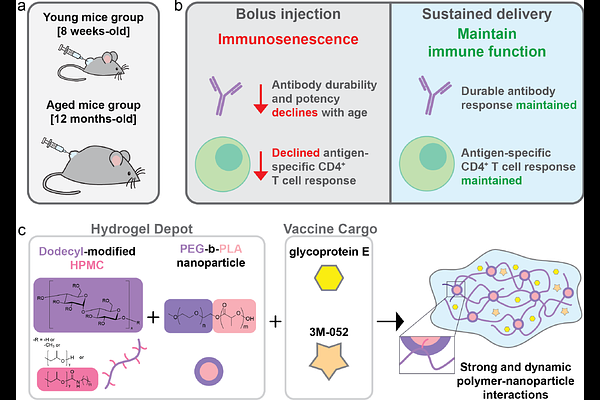
AbstractThe global aging population faces heightened vulnerability to infectious diseases due to immunosenescence, which diminishes the potency, durability, and breadth of vaccine-induced immunity. While the leading shingles vaccine, Shingrix, provides protection against herpes zoster virus for adults aged 50 and older, it is often associated with severe local and systemic reactogenicity, which limits vaccine compliance. Here, we report an injectable polymernanoparticle (PNP) hydrogel platform for the sustained delivery of a shingles subunit vaccine to enhance immune responses while mitigating reactogenicity in aged mice. Hydrogel-based vaccination elicited significantly more potent and durable humoral immune responses than Shingrix, while inflammatory cytokine levels remained below the limit of detection. Moreover, aged mice vaccinated with the hydrogel-based vaccine exhibited robust antigenspecific cellular immune responses. These findings demonstrate that controlling the temporal presentation of vaccine components can overcome age-associated declines in immune responsiveness without inducing excessive inflammatory signaling. By decoupling immunogenicity from reactogenicity, our hydrogel-based delivery strategy offers a promising approach to improve both the efficacy and tolerability of subunit vaccines for the elderly and may be broadly applicable to other vaccines targeting aging populations.