A New Method to Simulate Dark Matter-Baryon Interactions and Application to an Isolated Disk Galaxy

A New Method to Simulate Dark Matter-Baryon Interactions and Application to an Isolated Disk Galaxy
Connor Hainje, Glennys R. Farrar
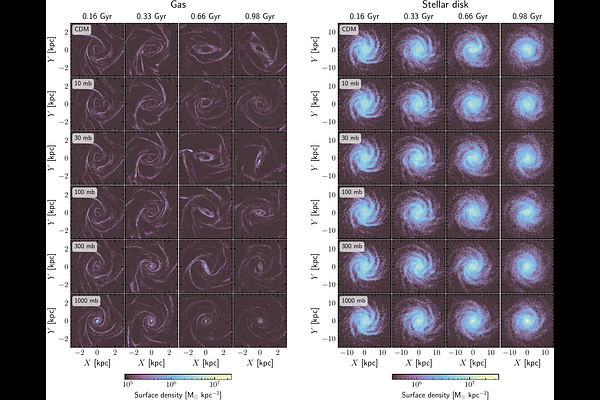
AbstractWe report on a new method for incorporating interactions between dark matter (DM) and baryons in cosmological simulations, capable of handling the challenging regime in which the dark matter particle mass is comparable to or lighter than the baryon mass. The method hybridizes two distinct approaches, as gas particles receive momentum and energy transfer according to a mean-field calculation while DM particles undergo Monte Carlo scatterings, which are derived from the Boltzmann equation and proved to be statistically equivalent. We present an open-source implementation of this method in the simulation code GIZMO. As a first application, we investigate the effects of DM--baryon interactions on an isolated Milky Way-like disk galaxy for dark matter having twice the proton mass, which roughly maximizes the average energy transfer per collision. For cross sections of order 1 barn ($10^{-24}\, \mathrm{cm}^2$), these interactions cause strong changes to the mass distribution in the center of the galaxy in less than 1 Gyr, even when bar formation is suppressed by hand. For cross sections typical of hadronic interactions, $\lesssim 30 \, {\rm mb}$, high-fidelity galaxy formation simulations will be needed to assess the effects on observable features of galaxies.