No global collapse of food webs across the Permian-Triassic Mass Extinction

No global collapse of food webs across the Permian-Triassic Mass Extinction
Karapunar, B.; Strydom, T.; Beckerman, A. P.; Ridgwell, A.; Wignall, P. B.; Dunne, J. A.; Little, C. T. S.; Hull, P.; Pimiento, C.; Dunhill, A.
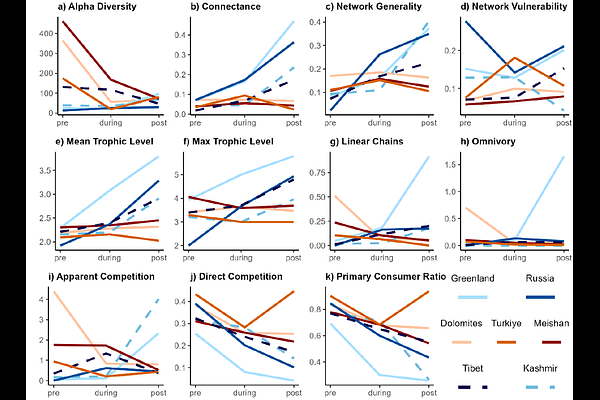
AbstractThe Permian-Triassic mass extinction (PTME), the Earth's most severe biotic crisis associated with extreme environmental perturbations, eliminated >80% of marine species. However, whether it triggered a globally pervasive top-down collapse of marine food webs, and whether recovery proceeded through bottom-up reassembly, remain unresolved. Here we reconstruct spatially explicit metacommunity food webs from seven regions spanning equatorial to high latitudes to test how extinction dynamics and ecosystem reorganization varied geographically. By integrating estimates of community structure and species interactions, we provide direct inference on trophic disruption across the PTME. Despite catastrophic species loss and flattening of the latitudinal diversity gradient, trophic collapse was not globally uniform, and higher trophic levels were not globally truncated. Instead, extinction selectivity was spatially heterogenous and tracked environmental severity. Benthic, low-motility herbivores with limited respiratory capacity were disproportionately lost, consistent with intensified warming, deoxygenation and disruption of primary productivity under elevated pCO2. Mid- to high-latitude communities became top-heavy and structurally complex, whereas tropical systems remained bottom-heavy and less robust to secondary extinction. These results demonstrate that trophic disruption and recovery were geographically structured, mediated by environmental forcing, species traits and pre-extinction food-web architecture, with implications for predicting marine ecosystem responses to ongoing climate change.