Learned Immune Architectures of Durable Antibody Responses Across Vaccines

Learned Immune Architectures of Durable Antibody Responses Across Vaccines
Hao, S. P.; Tomic, I.; Tomic, A.; Przytycki, P. F.
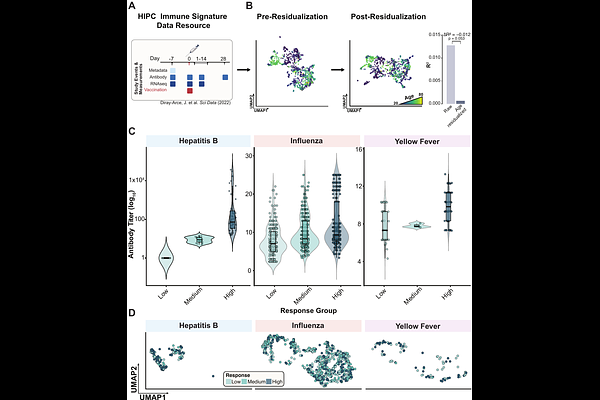
AbstractVaccination is one of the most effective public health interventions. However, vaccine efficacy varies widely among individuals, as immunity arises from complex interplay between genetic, pathogen, and immunological factors. To date, most systems vaccinology studies have remained pathogen-specific, precluding the discovery of potential shared immune architectures underlying durable antibody responses. To address this gap, we leveraged transcriptomic data from 1,032 participants receiving influenza, hepatitis B, or yellow fever vaccines to develop an interpretable machine learning framework for comparative analysis across diverse vaccine platforms. Pathogen-specific models using Blood Transcriptional Module-based feature aggregation accurately predicted high antibody responders and consistently outperformed gene-level models. Distinct predictive immune architectures identified across vaccines were further resolved for dominant hierarchical immune programs using surrogate decision trees. This approach identified the dominant decision boundaries underlying each vaccine model, highlighting leukocyte migration and Th2 differentiation in Hepatitis B, CD4+ T cells, M2 macrophages, and c-MYC signaling in Influenza, and B-cell receptor signaling with B-cell developmental pathways in Yellow Fever. Cross-pathogen concordance analyses further identified four shared transcriptional modules, suggesting partially conserved immune architectures across diverse vaccines. Together, these findings provide new insights into the immune mechanistic underpinnings of durable vaccine responses across vaccines and provide an interpretable framework for comparative systems vaccinology that may guide the rational design of next-generation vaccines.