Impact and interplay of $Λ$CDM analysis choices for LSST cosmic shear

Impact and interplay of $Λ$CDM analysis choices for LSST cosmic shear
N. C. Robertson, C. Heymans, J. Zuntz, P. Burger, C. D. Leonard, I. G. McCarthy, J. C. Paine, J. Salcido, N. Šarčević, M. Schaller, J. Schaye, M. P. van Daalen
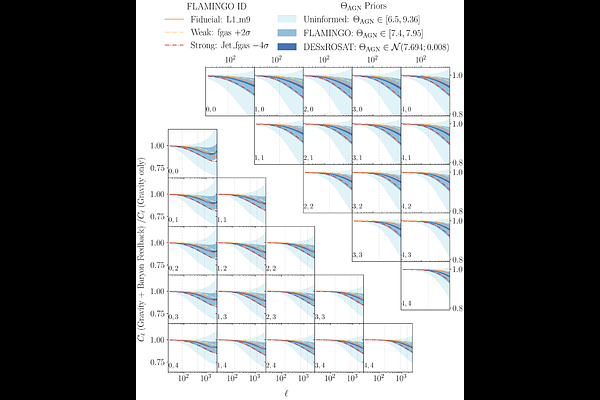
AbstractWe forecast cosmological parameter constraints for a cosmic shear analysis of the Rubin Observatory Legacy Survey of Space and Time (LSST), defining an analysis framework that can accurately recover the $Λ$CDM model in the presence of astrophysical and data-related systematics. When accounting for our present uncertainty on the suppression of the non-linear matter power spectrum through baryon feedback, we find that the error on the composite parameter $S_8=σ_8\sqrt{Ω_{\rm m}/0.3}$ almost doubles compared to an LSST analysis which neglects this astrophysical phenomenon. After the first year of observations, LSST will extend beyond the magnitude limit of existing representative spectroscopic calibration samples, requiring photometric redshifts to be calibrated using an alternative strategy. Adopting literature measurements of the reduced redshift calibration precision found from galaxy cross-correlation techniques, combined with current levels of baryon feedback uncertainty, we forecast final year LSST cosmic shear constraints that barely improve upon the first year analysis. This forecast therefore serves as encouragement to the community to develop methodology and observations to constrain models of baryon feedback and enhance photometric redshift calibration at depths where spectroscopy is unrepresentative. With tight priors on both these systematic terms, we forecast that LSST cosmic shear can deliver constraints on $S_8$ that are more than five times as constraining as existing cosmic shear surveys.