A Hybrid Origin for the Multiple Ring-Gap Structures in the Large Protoplanetary Disk V1094 Sco: A Low-Mass Planet and Secular Gravitational Instability

A Hybrid Origin for the Multiple Ring-Gap Structures in the Large Protoplanetary Disk V1094 Sco: A Low-Mass Planet and Secular Gravitational Instability
Masayuki Yamaguchi, Masahiro N. Machida, Ryosuke T. Tominaga, Jinshi Sai, Takayuki Muto, Michihiro Takami, Hauyu Baobab Liu, Ayumu Shoshi, Takashi Tsukagoshi, Shu Ishibashi
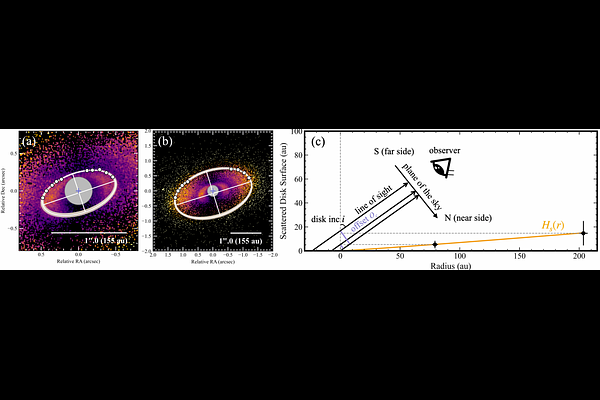
AbstractHigh spatial resolution observations reveal that some protoplanetary disks host multiple ring-gap pairs at large stellocentric radii, yet their physical origin remains unsettled. We present a multi-wavelength analysis of the V1094 Sco disk using Atacama Large Millimeter/submillimeter Array Band 6 continuum and $^{12}$CO and $^{13}$CO $J=2-1$ emission, together with a Very Large Telescope/SPHERE near-infrared scattered light image. The continuum image shows four narrow dust ring-gap pairs extending to exceptionally large radii ($r \sim 380$ au), while the CO isotopologues trace a spatially extended gas disk ($r \sim 760$ au) in Keplerian rotation. From the dust ring widths, we place conservative upper limits on the turbulent viscosity parameter, $α\lesssim 10^{-3}$ and potentially $\lesssim 10^{-4}$, implying weak turbulence. The ensemble of gap widths and depths is inconsistent with a simple one-planet-per-gap interpretation. At $r \simeq 100$ au, a double gap and its scattered light counterpart are consistent with multi-gap excitation by a single low-mass companion of $(55 \pm 35)\,M_{\oplus}$. At $r \simeq 170-230$ au, the outer ring system shows regular spacing and no clear scattered light counterpart, indicating mechanisms that operate primarily at the disk midplane. These outer rings are quantitatively compatible with secular gravitational instability. V1094 Sco therefore supports a hybrid pathway in which weak turbulence in an extended disk allows secular gravitational instability to assemble long-lived midplane dust concentrations that can cradle planet formation beyond $\sim 100$ au, alongside planet-driven substructures at intermediate radii.