Tracing the expansion of p53 retrogenes in elephant species: A foundation for functional insights.

Tracing the expansion of p53 retrogenes in elephant species: A foundation for functional insights.
Karakostis, K.; Campoy, E.; Puig, M.; Fahraeus, R.; Vollrath, F.; Caceres, M.
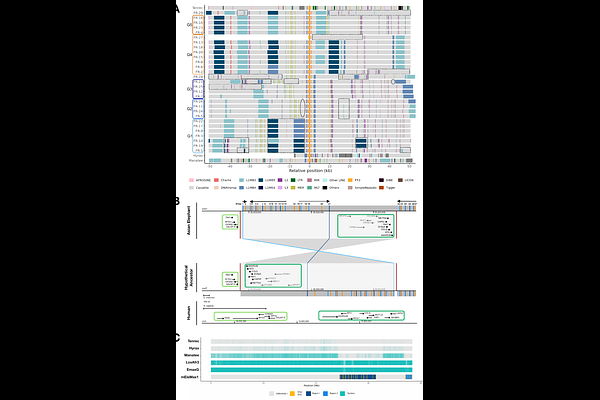
AbstractElephants have evolved multiple TP53 copies through a retrotransposition event followed by successive duplications. Some of these TP53 retrogenes (RTGs) are expressed and hypothesized to have functional roles in cellular regulation. However, comparative genomic studies on TP53 evolution and function are limited due to scarce genomic data for elephants and other afrotherians. Most existing research relies on scaffold assemblies of Loxodonta africana (LoxAfr3 and LoxAfr4), with some focus on Elephas maximus chromosomal assembly. In this in silico study, we analyzed three elephant genomes to validate TP53 RTGs, assess their copy variation, and trace their evolution. For the first time we describe 29 TP53 RTGs in E. maximus versus 18-19 in L. africana. These copies show sequence variation, especially in the duplicated regions and their flanking repetitive elements. Chromosomal mapping in E. maximus revealed that two major classes of TP53 RTGs are consistently arranged in pairs on chromosome 27, which harbours 27 of the 29 identified copies. The observed distribution strongly supports an evolutionary model in which large-scale genomic segments, each encompassing at least two retrogenes of different groups, were duplicated early in the elephant lineage, driving the extensive amplification of TP53 RTGs, as suggested also by the patterns of the flanking repetitive elements. The TP53 RTGs expansion was followed by a unique inversion on chromosome 27 that separates the duplication clusters. Thus, this study enhances our understanding of the elephant's multi-p53 system, linked to cancer resistance, body size, and Peto's paradox, and supports ongoing research into functional aspects.