Quorum sensing underlies the establishment and maintenance of marginal zone B cells

Quorum sensing underlies the establishment and maintenance of marginal zone B cells
Singh, A.; Verheijen, M.; Hogan, T.; Yates, A. J.; Seddon, B.; Rane, S.
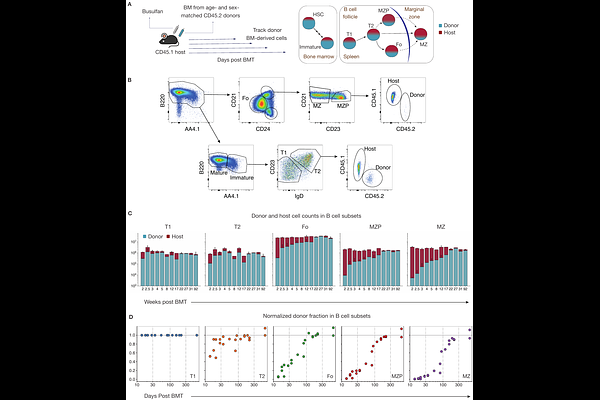
AbstractThe marginal zone (MZ) of the spleen harbors B cells that play an indispensable role in immune defense, orchestrating rapid responses to blood-borne pathogens. Under steady-state conditions, MZ B cell numbers are maintained through the balance of de novo generation from precursors, proliferative self-renewal, and loss. The mechanisms governing this homeostatic control remain elusive. Further, the developmental pathways underlying the establishment and continued supplementation of the MZ B cell compartment are not fully elucidated. To address these gaps, we combined multiple fate-mapping tools and mathematical models to study MZ B cell dynamics in mice across the life course. Our analyses find evidence of quorum sensing mechanisms that regulate both the accumulation of mature MZ B cells during early life and their maintenance throughout adulthood. Specifically, we demonstrate that they derive predominantly from transitional B cell precursors with an efficiency that increases with age, reaching stable levels only in adulthood. MZ B cells compensate for this early developmental inefficiency through cell density-dependent proliferation, ensuring the timely establishment of a stable pool. Collectively, these findings unveil critical roles of quorum sensing and immune system maturation in the maintenance of this vital B cell subset.