Reasoning as Attractor Dynamics: Latent Memory Retrieval via Gibbs-Weighted Energy Minimization

Reasoning as Attractor Dynamics: Latent Memory Retrieval via Gibbs-Weighted Energy Minimization
Kanishk Awadhiya
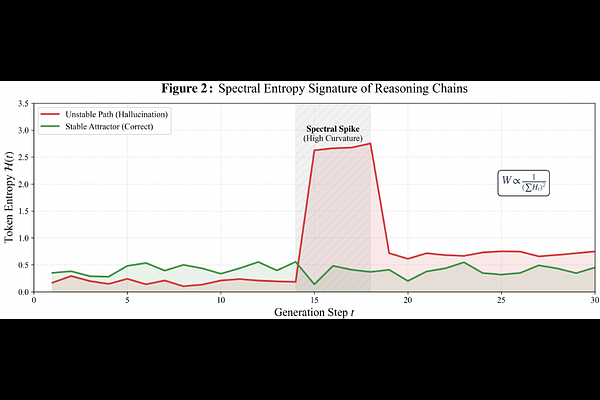
AbstractLarge Language Models (LLMs) are traditionally viewed as autoregressive generators. However, from the perspective of collective computation, they function as high-dimensional Dense Associative Memories that store complex reasoning patterns as latent attractors. In this work, we investigate the energy landscape of mathematical reasoning. We posit that correct reasoning chains correspond to deep, wide attractor basins ("flat minima") in the model's output distribution, whereas hallucinations manifest as sharp, unstable local minima. To exploit this geometry, we introduce a retrieval mechanism based on a Gibbs measure of the trajectory's spectral entropy. By sampling multiple reasoning paths and weighting them by their inverse energy ($P \propto e^{-βE}$), we approximate the equilibrium distribution of the associative memory, effectively ``relaxing'' the system into a robust solution. Empirically, this physics-inspired mechanism improves Microsoft Phi-3.5 performance on GSM8K by 5.38\% (84.7\% $\to$ 90.1\%), demonstrating that inference is better modeled as a dynamic settling process into an attractor basin rather than greedy next-token prediction.