Interferon-α and -β subtypes have temporally distinct roles in containing viral spread and protecting vital organs.

Interferon-α and -β subtypes have temporally distinct roles in containing viral spread and protecting vital organs.
Rezende Melo da Silva, C.; Roman, M. I.; Heath, N.; Gelman, M.; Keller, M.; Choi, J.; Tang, L.; Taiwo, O.; Kafle, S.; Torres-Gonzalez, E.; Ramage, H.; Andino, R.; Sigal, L. J.
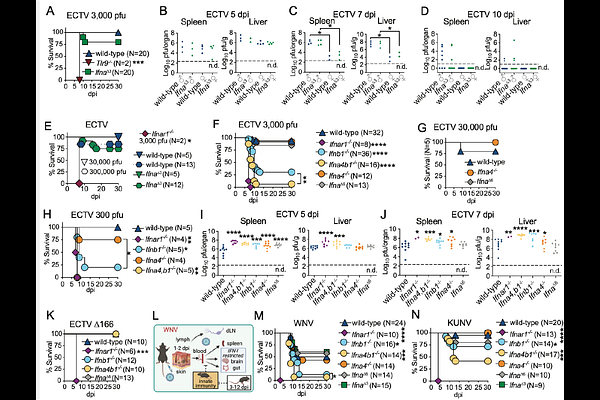
AbstractType I interferons (IFN-Is), including a single IFN-{beta} and over a dozen IFN-s, induce the anti-viral state. In vitro, IFN-{beta} transcription requires the assembly of the ''enhanceosome'' composed of the constitutive transcription factors NF-{kappa}B and AP-1, and either constitutive IRF3 or IFN-I-inducible IRF7. IRF3 and IRF7 transcribe mouse IFN-4 and human IFN-1 and -13. Only IRF7 transcribes other IFN-s. How IFN-I subtype multiplicity and their differential constitutive/IFN-I-inducible versus only IFN-I-inducible transcription help control viruses in vivo remains unknown. Using novel genetically modified mice, we demonstrate that most or all IFN-I subtypes, regardless of their transcriptional control, are necessary to curb the systemic dissemination of lymph-borne ectromelia virus (ECTV) but do not necessarily suppress ECTV or West Nile Virus (WNV) replication in the liver or the brain, or promote survival to their infection. Individually, the most critical IFN-I subtype to survive ECTV and WNV infections is IFN-{beta}. IFN-4 potentiates IFN-{beta} but is not essential. PRDII, the IFN-{beta} promoter's NF-{kappa}B binding site, which is required for enhanceosome assembly, is dispensable for in vivo IFN-{beta} production but complements IRF7-IFN-{beta} transcription to restrain ECTV and WNV. IFN-{beta} alone protects IFN--deficient mice from ECTV but not from WNV lethality. Control of WNV replication in the brain successively requires IFN-, IFN-{beta}, and then PRDII-dependent IFN-{beta}, suggesting that brain protection requires IFN-I production by various cell types and pathways. Thus, contrary to the prevailing view, in vivo, IFN-{beta} does not function earlier than IFN-, and IFN-I subtypes non-redundantly cooperate to restrain viruses in the periphery and in vital organs.