COSMOS-Web: Star formation along the early Hubble sequence and the evolution of dust over the redshift range 0<z<12

COSMOS-Web: Star formation along the early Hubble sequence and the evolution of dust over the redshift range 0<z<12
Stephen Eales, Matthew Smith, Tom Bakx, Jordan D'Silva, Feng-Yuan Frey Liu, Aparna Venkateshwaran
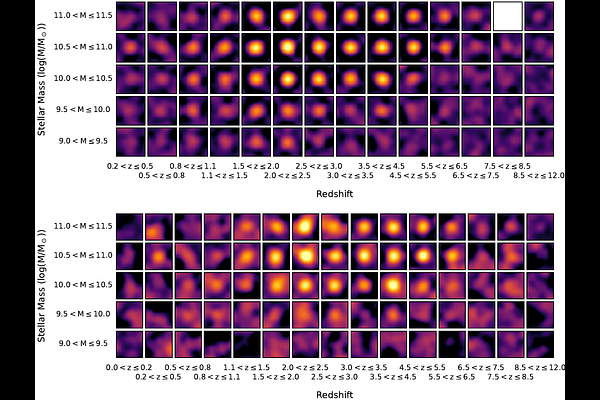
AbstractWe have carried out a stacking analysis with the COSMOS-Web catalogue on one of the deepest ever SCUBA-2 images at 850 microns, allowing us to estimate the mean submillimetre flux density for samples of galaxies split by stellar mass and morphological class over the redshift range 0<z<12. For all morphological classes, the mean star-formation rate estimated from the dust emission increases with redshift, reaching a value for the most massive galaxies (~10^11 soar masses) of >~80 solar masses per year at 2 < z < 4.5. In this redshift range, the mean star-formation rate for these galaxies falls along the Hubble sequence from ~280 solar masses per year for irregular galaxies at one end to ~80 solar masses per year for spheroids at the other end, which shows that quenching was already happening shortly after the emergence of the Hubble sequence. The decrease in the star-formation rate for the spheroidal galaxies can be reproduced with a `starvation' quenching model with a depletion time of ~10^{8.2} years. We also show that the transformation of `submillimetre galaxies' can reproduce the growth in number-density of massive bulge-dominated and spheroidal galaxies over the redshift range 1.5 <z < 4. As a side-project, we have used our stacking results to show that the ratio of dust mass to stellar mass in galaxies increases with redshift out to z~8 and to determine the relationship between the mean density of dust and redshift in the range 0 < z <12. We show that a chemical evolution model based on the `star-formation history' of the universe, with a gas outflow rate equal to the star-formation rate, can explain the monotonic rise in the dust-to-stellar mass ratio and reproduce the relationship between mean dust density and redshift remarkably accurately.