Maternal vaccination timing shapes the composition and maturation of antibody clonotypes transferred to the newborn

Maternal vaccination timing shapes the composition and maturation of antibody clonotypes transferred to the newborn
Yesbolatova, A.; Peyton, L.; Curtis, N. C.; Kim, T.; Yoon, J.; Melton, H. J.; Taher, N. M.; Yu, T.-G.; Kim, B. H.; Kansara, D. N.; Stoner, M. R.; Ober, E.; Varella, E.; Pannus, P.; DeBrabandere, L.; Maertens, K.; Hoehn, K. B.; Connors, M.; Marchant, A.; Ackerman, M. E.; Lee, J.
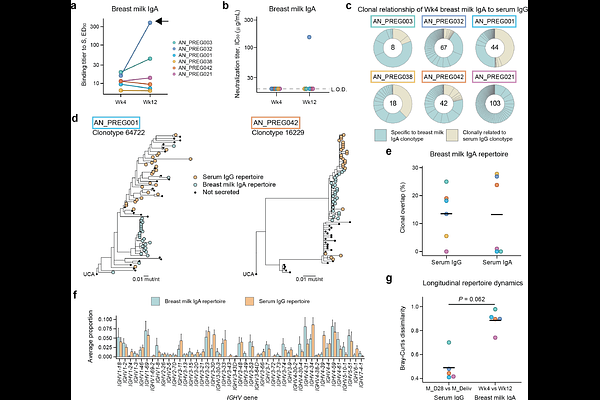
AbstractNewborns rely on maternally transferred antibodies for immune protection, acquired across the placenta and through breast milk. Despite this importance, how closely the inherited antibody repertoire resembles the mother's has not been examined at the clonotypic level. We combined BCR-Seq with proteomic Ig-Seq to track SARS-CoV-2-specific antibody clonotypes across maternal blood, cord blood, and breast milk from six mRNA-immunized pregnant individuals. Vaccination earlier in gestation generated more diverse peak IgG repertoires but greater contraction before delivery, yielding fewer transferred clonotypes. Vaccination later in gestation produced more restricted peak repertoires, but more clonotypes persisted to delivery and transferred to cord. Infant cord was enriched for persistent, highly somatically mutated, and intraclonally diverse IgG clonotypes, consistent with preferential transfer of affinity-matured antibodies. In contrast, breast milk IgA repertoires were largely distinct from systemic repertoires and underwent substantial remodeling despite stable antigen titers. These findings define molecular determinants of passive immunity shaped by vaccination timing relevant to optimizing maternal immunization.