West Nile virus capsid protein promotes viral replication and pathogenesis through PKCα-dependent lamin phosphorylation and nuclear deformation

West Nile virus capsid protein promotes viral replication and pathogenesis through PKCα-dependent lamin phosphorylation and nuclear deformation
Maezono, K.; Thammahakin, P.; Kataoka, M.; Suzuki, T.; Eguchi, H.; Thuy, D. T. N.; Yamaguchi, T.; Ota, A.; Itakura, Y.; Tabata, K.; Sawa, H.; Yoshii, K.; Kariwa, H.; Kobayashi, S.
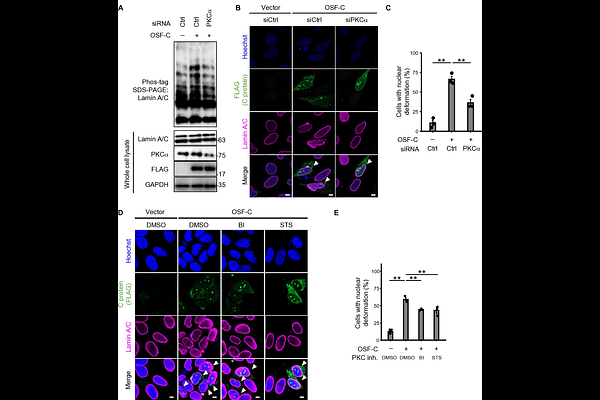
AbstractThe genus Orthoflavivirus comprises several medically important pathogens such as the West Nile virus (WNV), which causes encephalitis in humans. Although viral replication occurs in the cytoplasm, the capsid (C) protein of the orthoflavivirus is localized to both the cytoplasm and nucleus. Nuclear C protein contributes to viral replication and disease progression. However, the underlying mechanisms remain unclear. Here, we investigated whether the WNV C protein induces nuclear deformation and examined the underlying mechanism. We also assessed the contribution of this deformation to viral replication and pathogenesis. WNV infection and C protein expression induced morphological alterations in the nuclear lamina, leading to nuclear deformation. C protein expression enhanced lamin phosphorylation and the disassembly of the polymerized lamin network. In addition, C protein interacted with protein kinase C alpha (PKC) and localized PKC near the nuclear lamina. Downregulation of PKC expression inhibited C protein-induced lamin phosphorylation and nuclear deformation. In addition, both the downregulation of PKC expression and pharmacological inhibition of PKC reduced WNV replication. In contrast, the expression of phosphorylation-deficient lamin mutants attenuated the inhibitory effect of downregulated PKC expression on WNV replication. Furthermore, the pharmacological inhibition of PKC increased the survival rate of WNV-infected mice and suppressed both viral replication and nuclear deformation in the brain. Collectively, these results demonstrate that C protein remodels the nuclear lamina architecture through the PKC-lamin pathway, and that virus-induced nuclear deformation contributes to WNV replication and pathogenesis.