High-resolution detection of reflected light from the exo-Neptune LTT-9779 b

High-resolution detection of reflected light from the exo-Neptune LTT-9779 b
F. Borsa
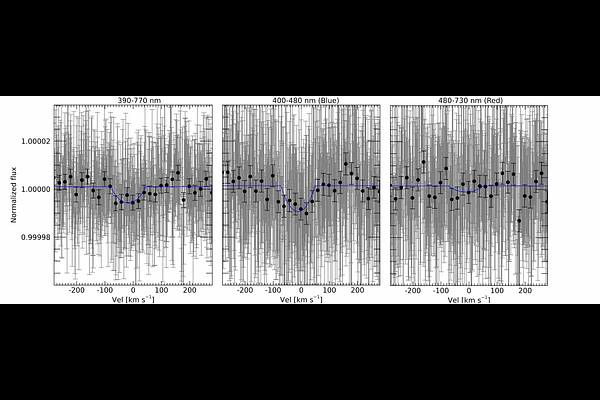
AbstractWhile high-resolution spectroscopy is routinely used to probe exoplanetary atmospheres, detecting reflected starlight remains highly challenging due to the extremely low planet-to-star optical flux ratios. We report the detection of reflected light from the ultra-hot exo-Neptune LTT-9779 b using high-resolution spectroscopy with ESPRESSO in its 4UT mode. By combining multiple epochs and applying a cross-correlation analysis with a theoretical reflection kernel, we were able to identify a faint signal matching the expected morphological and kinematic profile of the planetary reflection. This signature, whose presence has been detected at a signal-to-noise ratio of $\sim$5.4, exhibits a radial velocity semi-amplitude consistent with the expected orbital motion. We measured the planet-to-star flux ratio from the ratio of the equivalent widths of the planetary and stellar cross-correlation functions, finding $F_{\mathrm{p}}/F_\star = 102^{+29}_{-30}$ ppm for the ESPRESSO 380--770 nm wavelength range. Assuming a Lambertian phase function, this corresponds to a geometric albedo of $A_{\mathrm{g}} = 0.88 \pm 0.25$. The inferred albedo is consistent with previous space-based photometric measurements, suggesting a highly reflective atmosphere potentially dominated by scattering processes or high-altitude clouds. While we show that reflectivity is enhanced towards blue wavelengths, a detailed spectroscopic characterization of the planetary atmosphere from the reflected-light signal remains out of reach. This result highlights the scientific potential of future high-resolution spectrographs on extremely large telescopes, paving the way for systematic reflected-light detections across a broader exoplanet population, including cooler and smaller planets.