Turbulence destroys thermal lobes around Mars-sized planetary embryos

Turbulence destroys thermal lobes around Mars-sized planetary embryos
R. O. Chametla, A. Moranchel-Basurto, F. J. Sánchez-Salcedo
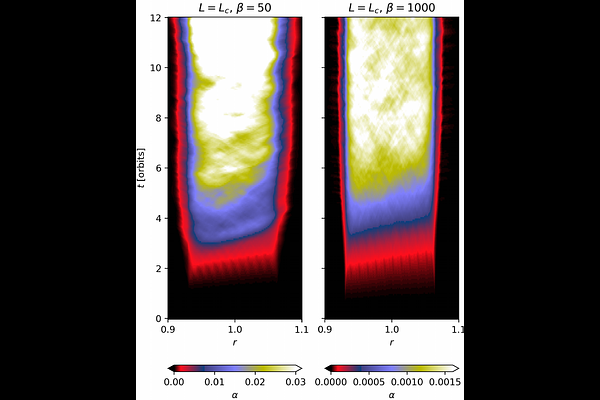
AbstractThe release of heat by a planetary embryo modifies the local density perturbations, forming thermal lobes in its vicinity, and thereby altering the torque exerted by the disk on the embryo. In laminar disks, these thermal torques can dominate the disk-embryo interaction, rendering the classical Lindblad and corotation torques largely subdominant. The aim of this work is to investigate how turbulence driven by the MRI instability affects the thermal lobes formed around a planetary embryo, and to analyze the resulting torque acting on the embryo. We evaluate the thermal torques exerted on a planetary embryo of mass $M_p=0.33M_{Mars}$ and on a planetary core with mass $M_{p}=1M_{\oplus}$, each embedded in a turbulent gaseous protoplanetary disk, by means of high-resolution 3D magnetohydrodynamics simulations that include thermal diffusion and an initially toroidal magnetic field. The magnetic field strength is characterized by the $β$-plasma parameter with $β\in\{50,1000\}$. We consider two values for the luminosity of the planetary embryo: $L=0$ (cold thermal lobes) and $L=L_c$ (hot thermal lobes), where $L_c$ represents the critical luminosity. We find that, even in the presence of a weak magnetic field and irrespective of the luminosity, for both planetary masses, the development of turbulence in the disk (which takes between 1.5 to 3 orbital periods) completely disrupts the thermal lobes. As a result, the torque acting on both the planetary embryo and the Earth-mass core displays a strongly oscillatory behavior. This suggests that planets with masses in the range $0.03M_{\oplus}\lesssim M_{p}\lesssim 1M_{\oplus}$ experience stochastic migration, as expected in turbulent disks. Thermal torques become inefficient in turbulent regions of protoplanetary disks, such as outside the dead zone, in both the inner and outer disk regions where the magnetorotational instability operates.